Showing posts with label north ridge. Show all posts

Thursday, January 7, 2016

Lost At Sea


The burial card and monument for Jacob F. Benjamin lists his date of death as Christmas Day, 1853 and it includes an intriguing notation - LOST AT SEA.  

It was December 25, 1853 when a vessel from the Pacific Mail Steamship Company encountered a terrible gale and foundered near Charleston.  The ship had left New York and was bound for Panama. Aboard were both soldiers (the ship was transporting the Third Regiment of the United States Artillery) and civilian passengers, including women and children. The decks were swept with wind and water, the smokestacks toppled, the boats lost.  Reports of the total casualties vary;  some contemporary newspapers reported about 300 casualties and 150 saved. First hand accounts of the disaster can be read here.

Among those reported dead that night was "The barber, colored, washed overboard."  This barber's name was not given in any accounts of the tragedy, but it was most certainly the same Jacob F. Benjamin; he Albany city directory for the same year lists him as a barber residing at 111 Knox Street.

His body was not recovered, but his name was carved on the marble shaft in a family plot deeded to his wife, Abigail.  At the time of his death, they had five children who ranged in age from an infant (his father's namesake) to eleven years old.  Jacob was thirty-five when he was lost to the waves.

The Benjamin plot is Lot 94, Section 100.  It is adjacent to the Arsenal Burial Ground and the grave of Dr. Thomas Elkins.

Monday, December 14, 2015

The Outwin Children

This memorial to three young children is cut to resemble two small side-by-side headstones, but the inscription (especially the third name and the epitaph) runs across them like a single stone.

The headstone marks the graves of three children, two of whom died within two weeks of each other and one who followed them just a few months later.  They were originally buried in the Dutch Reformed section of the State Street Burying Grounds and moved here at an unknown date.

John Outwin, departed this life March 14, 1833, aged 2 years, 2 months and 21 days.

Alexander McDonald Outwin, departed this life 1st March 1833, aged 3 years, 10 months and 23 days

Margaret Outwin, departed this life August 26, 1833, aged 5 years, 11 months and 5 days.

Loved youth, how short on earth your stay
Death his fell dart has hurled,
But soon your spirits found their way
To yon celestial word.
While fond remembrance reads your stone
And heaves the deep felt sigh,
We'll learn to lean on Christ alone
And in his bosom die.

They were the children of John and Margaret Outwin.  John was listed in city directories as an accountant at 144 Washington Avenue. He is not listed in the burial records, but Margaret is.  She died at the age of 90 on September 11, 1882 There was at least one sibling who survived to adulthood (yet still predeceased his mother);  there is a William Outwin interred elsewhere in the same plot who died on January 26, 1880 at the age of forty-five. 

Friday, July 31, 2015

Caught In A Landslide


Something about Section 189 on the North Ridge has always struck me as odd.

It's at an extreme corner of the Cemetery near the North Pond.  Behind the fence, traffic passes on Spring Street and houses have sprung up in the years since I first started exploring.  Sounds from Siena College often carry over.

The stones in this field are arranged very neatly and almost all face the same direction.  It's quite symmetrical compared to most lots where the monuments face whatever direction the owners wanted which gives the older sections a pleasantly disorganized look.


Many of the stones here are fairly old in what is a relatively newer section.  It doesn't appear on the extremely useful 1912 lot map, yet many of the stones predate it.  A search of all burials in Section 189 shows that burials in this section only began in 1941,, but clearly some of these stones are far older.  Many date from the mid to late 1800s.


Researching a few of the names found on the older stones revealed another interesting detail.  I picked one of the names - Charles Angus who died in 1875 - and checked the burial index cards which showed he were buried in Lot 22, Section 89. 

Several of the Angus family stones in Section 189

For a moment, I thought it could be a typo - that perhaps it was supposed to read "189," but the "1" was accidentally omitted.  A check of a few other names, however, showed they were all listed as buried in Section 89. 


Several years ago, when I began my research, I came across a passing reference to a landslide in a back issue of the Friends of the Albany Rural Cemetery's newsletter.  More recently, I found a brief article in the defunct Knickerbocker News describing a court case in which the Cemetery sought and obtain permission to move a number of graves which had been affected by a landslide.  The article didn't mention what part of the Cemetery had been damaged by the landslide, but the connection was clear.

In 1951, a landslide caused part of Section 89 to collapse.  Section 89 overlooks the Kromme Kill ravine and the remains of Lake Bathesda.  The landslide caused some graves and monuments above the old Bramble Copse walk to tumble into the ravine.

Detail of an 1871 map showing Section 89.

As a result of the landslide, approximately 150 graves had to be removed from the portion of Section 89.  The article didn't mention where the graves were going to be placed.  However, a second check of records for the Angus family and a sample of other names on those older monuments in that far corner of Section 189 showed they were all not only listed as Section 89, but most came from lots along the edge of the ravine overlooking Bramble Copse Walk.

Map from 1912 showing the original location of the Angus lot on the ravine side of Section 89.  The wavy parallel lines in the lower left of the corner are part of the lake.

These monuments seems subtly out of place because, in a way, they are.  The older gravestones in Section 189 are those which were relocated after the 1951 landslide damaged Section 89.


Friday, July 10, 2015

Spencer Stafford


When the Hallenbake Burial Ground, the last family cemetery in Albany, was removed from the corner of South Pearl and Hamilton Street in 1860, the remains of Spencer Stafford and his family were among those transferred to the Rural Cemetery's North Ridge.

A native of Rhode Island, fifteen year old Stafford came to Albany in 1787..  His brother, Thomas, and other relatives had already settled in the city and young Stafford became an apprentice in Thomas' Market Street store.  At the age of nineteen, he married into the Hallenbake family when he wed Dorothea.  The couple built a home on the Hallenbake land, but in 1790, relocated to Deerfield, Oneida County where Stafford was briefly engaged in the manufacture of potash.  A year later, however, the Staffords returned to Albany permanently. 

Stafford was described as "self-reliant, industrious, and enterprising" and as possessing "qualities essential to mercantile success."  A silversmith as well as a merchant, he also entered into the stovemaking business and  held various civic positions, including service as a city alderman.

Spencer Stafford would eventually build a mansion on Lydius Street;  the house still stands as 100 Madison Avenue.

Dorothea Stafford died in 1806, two years before Spencer built the Lydiys Street house.  The couple had five children.  A year later, Spencer Stafford married Harriet Romeyn by whom he had four more children.  Portraits of both Spencer and Harriet are now in the collections of the Alban Institute of History and Art and appear in their digital collections:

Portrait of Spencer Stafford by Ezra Ames
Portrait of Harriet Romeyn Stafford by Ezra Ames

Spencer Stafford died on February 10, 1844.  He laid to rest in the Hallenbake family's burial grounds where his first wife was already buried.  Harriet Romeyn Stafford survived her husband by five years and, after her death on July 5, 1849, was also buried in the Hallenbake cemetery.  In June 1860, all remains from this family burial ground were removed to the Rural Cemetery.  A sandstone monument marks the Staffords portion of the large Hallenbake plot.  Footstones with their initials mark the graves of Spencer, Dorothea, and Harriet while inscriptions on the sandstone monument memorialize

Tuesday, June 9, 2015

A Sweet Surprise


As mentioned in a previous post, the Rural Cemetery has been full of surprises this spring.  As I stopped to take a picture on the North Ridge near the Kreuder monument, I noticed something different set against the trees at the edge of the ravine.

From a distance, it was actually difficult to tell just what was set atop this tall monument.  At first, it appeared to be a large bird, but it was too still and lacked the coloring of the hawks which are fairly common here.  It might have been a simple draped urn or even a statue.  Upon a closer look, it turned out to be the latter.

It's located not too far from the Hallenbake lot and the little headstones of the Prentice daughters.  It was also mentioned in Henry Churchill's 1858 Guide Through The Rural Cemetery.  Yet, somehow, I'd never seen it before.  Perhaps because, the last time I was close to it, I was limping along with a cane and, on previous wanderings, I was too busy picking my way down the marble steps that lead from the Hallenbake enclosure to the old, narrow path that runs along the north shoulder of the ravine.

One reason it's easy to miss is because it was meant to be seen from that path, identified on older maps as Dell Side Avenue.  It faces the ravine and, when the old bridges which linked the North, Middle, and South Ridges, there would have been several scenic approaches to this lot.  From the lot, there would have been a lovely view of the Kromme Kill and Indian Lake.


The little statue atop the monument turned out to be quite familiar.  I've seen examples of this kneeling child before.  There is a similar one in Schenectady's Vale Cemetery and other copies appear in burial grounds around the country.  A similar figure also appears as a stock image in old advertisements for stonecutters such as William Manson and James Gazeley. 

A check of burial records shows that this is the Anderson family monument and there's the sweet aspect;  the Andersons were in the candy business.  A city directory from 1848 lists George Anderson as a "Plain and Ornamental Confectioner" at the corner of Broadway and Lydius Street (now Madison Avenue).  The advertisement offers various sweet goods such as ice cream, jellies, cakes, and pastries.  A few years later, the 1853 directory featured a full page advertisement for Anderson & Wright, a well-stocked candy "manufactory" and soda foundation.

George Anderson was born in England around 1818.  His burial records state he died of consumption on March 11, 1856.  His widow, Sarah, was born in Berne, New York in 1820.  She passed away on Christmas Eve, 1879.  About a dozen other family members are interred around this lot, including George's siblings, Charles and Mary Anderson.  Charles and Mary both died of consumption within days of each other;  thirty-five year Charles on March 8, 1844 and twenty-nine year old Mary on March 14, 1844 died on March 8, 1844.  The Rural Cemetery had not yet been consecrated so Charles and Mary were temporarily interred at the State Street Burying Grounds as their burial records indicate that they were "removed from Albany" to this lot.
 The ad above is borrowed from the Albany...The Way It Was image collection on Flick.

Friday, June 5, 2015

Catharine Ann Van Benthuysen


This stone on the North Ridge is beautifully detailed;  elegant and Gothic, it features a rose and a tulip on either side of a niche framing a worn figure of an angel.

It marks the grave of a Catharine Van Benthuysen who died on August 23, 1854.  It does not give her age or date of birth.  The lower part of the stone might contain additional information or an epitaph, but the slab has broken off its base and the bottom portion is obscured now.  The burial records on file indicate she was twenty-three at the time of her death.

Census records for 1850 show a sixteen-year old Catharine A. Van Benthuysen, the daughter of Watervliet farmer Volkert Van Benthuysen and his wife, Dorcas.  Catharine's parents are also buried in the plot, as well as Ida, a two-year old sister who died just a month after Catharine.


Saturday, May 23, 2015

The Daughters of John and Sarah Prentice


Last week's walk through the North Ridge on the way to Dianna Mingo's grave yielded quite a few wonderful surprises, especially in areas explored many times before.

Marble headstones with sleeping infants are fairly common, but usually they are quite tiny with the reclining figures being no large than small dolls.  So, this peaceful child was almost startling as it is nearly life-sized.  Beside it, a small headstone depicts a young child kneeling.

Located just beyond the fenced Hallenbeek lot where the hillside slopes down towards the Kromme Kill ravine and an old path called Dell Side Avenue, the lot features two poignant headstones marking the graves of Sarah and Jane Ann Prentice.

Sarah died April 13, 1860.  She was just twenty-nine days old.  Her monument is the reclining infant.  Beautifully detailed, it shows the sleeping child dressed in a thin nightdress that is almost invisible due to erosion of the stone.  Beneath her blanket, there is a cushion with tassels.  One end of the headstone reads "Gone Home."


Jane Ann died on September 5, 1857 at the age of one year, four months, and seven days.  Her headstone shows a child kneeling amid what appear to be cushions.  Her face is eroded, but one tiny hand points toward Heaven.  The top of the stone is decorated with carved flowers.


 As with many early burial records, there is no cause of death given on their index cards. 

John F. Prentice, identified in census records as a schoolteacher, died only a few years after his little girls.  He passed away on April 30, 1862.  He was only thirty-two.  His widow, Sarah Lansing Prentice, survived him for many years.  She died of asthma on November 10, 1904 at the age of seventy-six.  Both John and Sarah are buried in the same lot as their children, but their gray granite headstone has toppled from its base.


Both Sarah and Jane Ann's gravestones are signed by their maker, Tuckerman & McClelland located on Lydius Street (now Madison Avenue)  Below is an advertisement for the Marble Works from Albany Argus in 1860.

Wednesday, May 20, 2015

An Iron Acorn


An acorn finial decorates an old iron plot fence on the North Ridge.  Later that same day, I came across another acorn finial near Washington Park.

Monday, May 18, 2015

In Search of Dianna Mingo


Several months ago, while transcribing this 1873 newspaper article about the Albany Rural Cemetery, a reference to an 1872 interment certainly stood out.

An unusual record appears upon the register of interments for last year – that of the burial of Diana Mingo, a colored lady aged 106 years. She was the oldest person ever buried in the cemetery.

A further search of the Albany Evening Journal turned up a very detailed article on this centenarian which was published on July 30, 1872.

The Funeral of A Centenarian - Albany's “Oldest Inhabitant” - A Life Begun In The “Good Old Colony Times” - A Remarkable Old Woman and a Veritable “Mother in Israel”

On Sunday afternoon, one of the rarest of events occurred at the African Methodist church on Hamilton street, near Lark, in the celebration of the funeral services of one whose life had exceeded a full century, who died at last with mental faculties unimpaired and whose clear remembrance extended to early childhood, thus covering the entire history of a great nation.

Tuesday, April 21, 2015

The Children of Henry & Matilda Cross


This tiny cast iron angel sits atop a plain marble shaft on the North Ridge.  Currently painted yellow, it was light blue about fifteen years ago.

With small wings, a rather anxious pose, and an almost folk art look, this angel marks the grave of "The Children of Henry & Matilda Cross."  The children's names and dates of death are listed on one side of the monument, but no ages are given.

Samuel - died November 25, 1838
Martha M. - died March 11, 1843
Alexander - died August 26, 1845
James Peter - died March 5, 1847
Joseph W. - died June 18, 1849
William Henry - died February 23, 1853
Francis H. - died October 3, 1847

The other sides of the shaft are blank and the parents are not buried here.  Since several of the children died before the Cemetery was established, they may have originally been buried at the State Street Burying Grounds and moved here at some point between 1844 and 1869.

Most of the burials in Section 99 are African-Americans and the 1840 census indeed lists Henry Cross as black.  He is identified as a laborer who resided at 245 South Pearl Street with his family.  Later, the family resided on Knox Street near Lydius (now Madison Avenue).  The census also notes he was born in South Carolina in 1810.


Thursday, April 9, 2015

At Rest In The Clover


Today marks the 150th anniversary of the Civil War's end.  Above, a soldier's headstone amid the deep grass and clover of the Albany Rural Cemetery's North Ridge.

For some past Civil War posts, click here.

Thursday, February 12, 2015

The Soldiers Monument

In honor of Lincoln's birthday and Throwback Thursday, a view of the Civil War monument that faces the Soldiers Lot on the North Ridge.  The photo, taken around 1900, shows the granite plinth surrounded by urns of foliage, and iron markers such as the Grand Army of the Republic.  The plaques on the monument were cast from captured Confederates by Congressman (and former Albany mayor) Eli Perry. 

The front of the monument features an oval bronze medallion of President Lincoln.  The laurel wreath surrounding the President's likeness is visible in this photo, but was unfortunately stolen in the 1990s.  The medallion itself is signed "Pickett 1873" and seems to have an interesting history.

Saturday, February 7, 2015

Rachel Groesbeck Van Santvoord


While transcribing some Dutch Reformed burial ground inscriptions from one of Joel Munsell's many and always useful volumes of Albany history, one particular inscription stood out from the long list.

In memory of Rachel Groesbeck, Wife of Anthony Van Santvoord, who departed this life in the middle Dutch church, the 8th day of March, 1835, aged 60 years, 2 months and 3 days. 

 While seated in the house of God To worship him she loved, He called her from his house below, To worship him above.

It's the first time I've encountered the epitaph of someone who passed away during church services and I was certain that, while I didn't recall seeing that part of the epitaph, I had indeed seen the name on headstone and photographed it.  It took a bit of searching, but I finally located the photo in a folder full of iron fences, toppled tombstones, fallen trees, and other odds and ends from the Cemetery's North Ridge.

It's an old marble slab-style headstone now flat and embedded in the ground on the same high hill as David Strain, the Lockwood family and the Lochner monument with its pretty urns.  Between the usual darkening of the stone and the overlapping turf, it was easy to miss the complete inscription at the time the photo was taken.

The daughter of Anthony Groesbeck and Cathalyntje De Forest, Rachel was born on January 5, 1775.  She married Anthony Van Santvoord (also spelled Santvoort) in 1806. She was his second wife;  his first wife, Maria Roff, had died in 1800 at the age of thirty-four.  

Anthony Van Santvoord, who resided on Market Street (now Broadway), was a merchant and, like Captain Bogart, one of the last of Albany's Hudson River skippers.  He died in 1852 at the age of ninety.  After his death, he was extensively profiled in Munsell's Annals of Albany.


Friday, February 6, 2015

Gertrude Justine Norman


This lovely, but unfortunately toppled headstone on the North Ridge (not far from the Soldiers Lot and Hallenbeck family plot) has an elegant Gothic style and beautiful lettering.  The crosses flanking the surname are rather interesting;  the one on the right is simply a series of dots.  Was it meant to be this way or were the dots a guide for the carver who left it unfinished? 

The stone marks the grave of the infant daughter of Albany architect Thomas E. Norman whose work included the First Lutheran Church (at the time located at Pine and Lodge Streets). Perhaps he also designed the stone for his child's grave.  He died in 1873 and is also buried in this family lot.

Friday, October 10, 2014

David Zeh

This fascinating stone lies well off the main road along the North Ridge.  It faces away from the road and looks towards the Kromme Kill ravine.  In between mowings, it can quickly be swallowed up by the tall grass and clover.

The monument is made of a reddish-brown sandstone and, considering how easily this material erodes, the carved details are in fantastic shape.  If you look closely at the bottom right corner below the name, you'll see it's signed by James Gazeley.  It's likely one of his earlier works. 

The style is almost whimsical and folksy;  an angle bearing tablets carved with the words "EVEN SO" emerges from puffy clouds that almost resemble clusters of grapes.  Below the heavenly messenger, there are old-fashioned scales piled with scrolls.  There is a passage from Corinthians on either side of the scales.  Above the angel, it reads, "Scripture Balance."  Below, it reads, "On Earth Peace Good Will Toward Men."  The top of the monument is certainly missing something;  a column or urn or obelisk would've have completed it. 

This unusual stone marks the grave of David Zeh who died on April 8, 1880, but was likely erected well before his death to mark the graves of other family members.  The first burials in this lot took place in the 1850s and David Zeh probably commissioned the monument then.

David Zeh, who was born in Berne, New York in 1802, was a Trustee of the First Universalist Church in Albany.  City directories identify him as a merchant at the corner of State and Hawk Streets (with a residence nearby at 7 High Street).  Based on the burial records, it would seem he married twice;  his first wife, Catherine, died in 1833 at the age of twenty-eight.  His second wife, Mary Janes, survived him and passed away in 1893.


Saturday, October 4, 2014

Stephen Lush

Set on the edge of the North Ridge overlooking the Kromme Kill ravine, this tall marble monument marks the grave of Stephen Lush and his family.

A native of New York City, he studied law and moved to his brother's home in Albany just before the Revolution.  He served very actively during the Revolution.  He was a member of the Albany Committee of Correspondence and served captain of the New York Volunteers.  He later joined the Fifth New Jersey Regiment and served as an acting judge advocate general.  As an aide-de-camp to General George Clinton, he was captured by the British when Fort Montgomery fell in 1777.  He was released in a prisoner exchange the following year.

After the war, he returned to Albany and married; his wife, Lydia, was the daughter of Dr. Samuel Stringer.  One of their children who died in infancy is buried in the Church Grounds.  Their Market Street house adjoined that of Dr. Stringer.  Lush was among the last slave owners in Albany, owning slaves as late as 1820.  A successful attorney, he served multiple terms the State Assembly and Senate.

Lush died in 1825 at the age of seventy-two.  Since he is not listed in the Common Council's inventory of interments in the State Street Burying Grounds, it's likely he was originally buried in the String family vault which stood in a small private cemetery leased by David Vanderheyden at what is now the northwest corner of Washington Avenue and Swan Streets. 

His wife, one son, and his brother are also listed on the east face of this monument.  When it was originally erected, this plot commanded a very fine view of the ravine below with two ornamental bodies of water, Lake Bethesda and Indian Lake. 

Wednesday, September 3, 2014

John Kolkanis

This tiny headstone on the North Ridge (not far from the G.A.R. plot) is fairly unique.  It includes a photograph of the deceased;  such headstone photos are not common in the Rural Cemetery, though I have seen a few other examples in other local cemeteries such as Calvary in Glenmont.

The grave belongs to one John Kolkanis, though his name is spelled "Colcanis" on the stone.  He was born in Greece and, at the time of his death, resided at 469 Delaware Avenue (near the corner with Whitehall Road).  The burial record lists his cause of death as "Drowned in the Hudson River," but search of local newspapers didn't reveal any any additional details.

Tuesday, August 19, 2014

The Albany Medical College Lots


Located not far from the massive Winslow family tomb at the low, eastern edge of the North Ridge, these small granite mark lots reserved for the remains of individuals who have donated their bodies for anatomical research and other study at the Albany Medical College.


The Times Union has a feature on yesterday's service in honor of over three hundred people newly interred here.


Monday, August 11, 2014

Doctor Thomas Elkins

This weathered marble monument stands near the crest of a low hill overlooking the Arsenal Burial Ground on the North Ridge.  Though eroded, the lettering can still be read:  DR. THOS. ELKINS 1818-1900.

Elkins was a doctor, an inventor, and a prominent member of Albany's 19th-century African-American community.  He studied surgery and dentistry under Dr. Alden March, a founder of the Albany Medical College.  Elkins operated a pharmacy on North Swan Street which he later relocated to Broadway at Livingston Avenue (the latter was still called Lumber Street at the time).  According to contemporary newspaper reports, the front window of the pharmacy was blown in by the powerful explosion of a nearby locomotive on February 25, 1867.

He seems to have taken at least a passing interest in horticulture as well;  in 1886, a committee of the African Methodist Episcopal Church agreed to plant a memorial tree in Washington Park and the tree in question was one grown from seed by Dr. Elkins.  The committee included a son of Samuel Mando.  Elkins also made a trip to the then newly-formed nation of Liberia and is reported to have brought back a collection of African artifacts, shells, and minerals, though the fate of his collection is not known. 

Elkins is perhaps best remembered as part of Albany's Underground Railroad. For a time, he lived a few doors away from Stephen and Harriet Myers on Lumber Street and actively took part in their work.  He is identified as a member of the local Vigilance Committee which assisted slaves fleeing The South.  As a trained doctor, it is more than likely he was able to offer medical assistance to those fugitives in need of such care.  During the Civil War, he served as a medical examiner to the 54th Massachusetts Volunteer Infantry (the unit made famous in the film Glory).

Elkins was also well-known as an inventor.  His work as a medical examiner led him to develop and patent a unit for the cold storage of corpses which is said to have been a forerunner of the refrigerator.  For this innovation, he received a certificate of "highest merit" from the New York Agriculture Society.  He also patented several pieces of multifunctional furniture, including a combination of a commode, washstand, bureau, mirror, chair, table, and bookshelf intended to save space in a small room. 

Elkins died in on August 10, 1900.  He was eighty-eight years old and the cause of his death was listed as apoplexy.  His funeral from his home at 888 Broadway was presided over by the canon of the Cathedral of All Saints and his pallbearers were the sons of several of his closest friends.


More on Elkins' inventions can be found here, including diagrams. 

Sunday, August 10, 2014

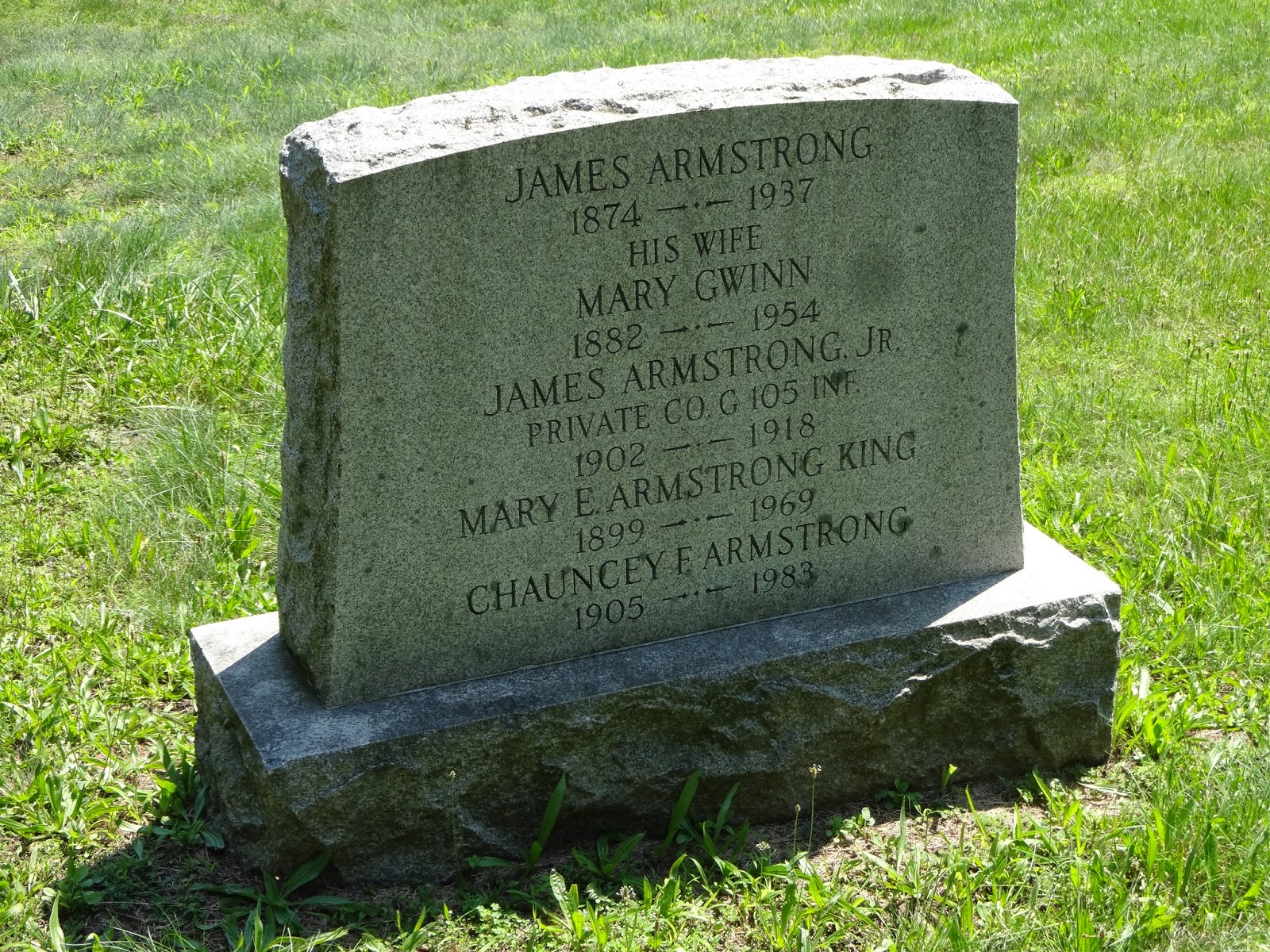
Private James Armstrong


Private James Armstrong was only sixteen when he was killed in action in Belgium during World War I. 

The son of a coal handler (who, according to census and burial records, lived at 1226 Fifth Avenue in Watervliet), he died in Belgium on August 3, 1918 while serving in Company G of the 105th Infantry. 

Originally interred in Belgium, his body was exhumed by the U.S. Government and returned to his family for reburial in the Albany Rural Cemetery on April 10, 1921.