Showing posts with label middle ridge. Show all posts

Monday, February 15, 2016

Rediscovering A Soul Effigy


A recent research walk on the Rural Cemetery's Middle Ridge revealed a few interesting surprises, including only the second marble section marker I've seen intact.  Stopping near the wonderfully eclectic monument to Ozias Hall to retrieve a lot map from my backpack, I happened to look back down the hill toward a corner lot I'd visited several years ago.  

There's a cache of older headstones there, mostly transferred from the State Street Burying Grounds and laid flush to the earth in a large family plot.  I'd photographed a few of them back in 2013, but gave up because several of them were positioned at the very edge of a short, but very steep slope.  Since I was using a cane as I recovered from a badly dislocated knee, I didn't want to risk a tumble! 

As I looked down from the Ozias Hall lot, I noticed about two or three headstones in that corner lot.  These had not been visible on that previous visit.  They looked quite old so I retraced my steps back down from the Hall lot for a closer look.  One was fairly plain;  the inscription was partially obscured, but I could make out a partial date of 17--.  The stone next to it was heavily embedded in the earth.  Only a couple of inches were visible with most of the slab covered in very thick moss and the upper portion overlapped by a tree root.

But there was something interesting on that upper portion.  A row of tiny parallel lines was just visible under a layer of thick dirt and moss.  It hinted some sort of carving, perhaps the bottom edge of wings.  It might even be a soul effigy - the winged faces popular on 18th-century tombstones.  They were not particularly common in Albany compared to New England and the lower Hudson Valley, but there are some interesting examples in the Church Grounds and the Schuyler lot.  Many, though not all, of the Cemetery's soul effigies are documented in Experiencing Albany:  Perspectives On A Grand City's Past.

I keep a few "tools" in my backpack when I'm at the Cemetery, including a soft brush which I used it to sweep the dirt from the upper part.  And, yes, there was a soul effigy complete with a fashionable wig atop on oval face.  There is even a hint of a heavenly crown peeking out from under the turf.


The inscription was much harder to reveal with just the brush.  But I was able to clear just enough to reveal some elegant flourishes and enough letters to copy for identification.

The headstone belongs to Jacob Ten C. Eyck who died on September 8, 1793.  Born in Albany in 1705 to silversmith Coenradt Ten Eyck and Gerritje Van Schaick Ten Eyck, he followed in his father's line of work.  As a young man, he apprenticed to Charles Le Roux in New York City.  He returned to Albany around 1736 where he practiced his trade as a smith - an example of his work is currently on display as part of the Albany Institute of History & Art's excellent exhibit, Masterworks - 225 Years of Collecting.  He also served as constable and city firemaster and, eventually, as sheriff of Albany County.  From 1748 to 1750, he served as Mayor.

In 1736, he married Catharina Cuyler.  They had four children.  Catharina died in 1790.

Jacob C. Ten Eyck was eighty-eight at the time of his death.  He was buried in the Dutch Reformed Church's section of the municipal burial ground which closed in 1868 to allow the land to be redeveloped into Washington Park.  While most graves were relocated to the Rural Cemetery's Church Grounds, Jacob C. Ten Eyck's was moved to this large plot in Section 60.  Records indicate that Catharina was also moved here and her headstone is likely nearby, waiting to be cleared, too.

 AIHA - a silver bowl by Jacob C. Ten Eyck

Sunday, September 13, 2015

The Disappearance of Robert Harper

This lovely monument with a heavy, tasseled pall draped over a marble shaft and a wreath of flowers encircling an urn with flames is located on the slope of the Middle Ridge just across from the Cemetery's chapel.

The monument marks the grave of Robert Harper and the inscription notes that he died January 22, 1870.  He was buried on April 24 of the same year.

Born in Ireland around 1811, Robert Harper is listed in Albany city directories as a vegetable merchant, first at the city's central market and, later, at 90 State Street.  His home was on Lydius Street (now Madison Avenue) near Partridge Street.  City directories also show as John Harper at the same house and give his occupation as a gardener.  Robert and John appear to have been brothers.  Robert also served as an alderman in the city's 10th Ward.

According to an article which ran in The Albany Evening Times, Robert Harper had "risen from obscurity to affluence and an honorable position among our citizens."  Property maps shows that his property covered about twelve square blocks from old Lydius Street south to Gansevoort Street between Partridge Street and Main Avenue

Late on night of January 22, 1870, he was seen leaving the Watkins House, a restaurant at 100 State Street, but he never arrived at home.  There were rumors that he was kidnapped, robbed, and murdered.  There were even several arrests made in connection his disappearance, but no one was charged.

The following April, after a period of spring rains, a body was found in the Hudson River at Coeymans by John Hounstein, an "old gentleman" who had charge of the lights on the Coeymans dyke.  Described as "poor, honest, and hardworking" by the newspapers, Hounstein spotted the body near the dyke, fastened it to his little boat, and towed it to land.  It was April 19, a little over four months after Robert Harper walked out of the Watkins House for the last time.

A doctor was summoned to examine the body.  The doctor detected no signs of violence and it was decided that no foul play was involved in the death;  it was presumed that Harper fell into the river basin at the foot of State Street and his body was held in place over the winter by boats, only to be washed downstream in the spring.  An examination of his pockets found a copy of Harper's Magazine, a gold watch on a chain, keys, a pocketknife, a corkscrew, a pocket ruler, and a packet of personal and business papers. 

Justice McNamara, identified in the newspapers as a relative of Robert Harper, rushed to Coeymans by tugboat in the company of the coroner and two detectives who had been investigating Harper's disappearance.   They identified the body as Robert Harper.  A further search of the deceased reveal several packets of money totaling $829.

Robert Harper's remains were returned to Albany and brought to the Morange undertaking rooms, then located at 39 North Pearl Street.

 The Morange Undertaking Ware Rooms ca. 1871 - photo from the Albany Public Library and the Albany...The Way It Was group archive on Flickr.

Robert Harper was buried in Lot 3, Section 62.  The burial records note that his second wife, Susan, instructed them to bury him beside his first wife, Sarah E., whose date of death is not listed in the records.  His first wife must have died at some point after the 1860 census.

Friday, June 19, 2015

Cretia Jackson


 There are two Boyd family lots near the western terminus of the Middle Ridge;  the lot of James and Peter Boyd marked with a large, simple marble obelisk and the lot of Robert Boyd is marked with a towering and elaborate monument which features a sarcophagus, a winged hourglass, and heavy lions' feet. 

In the latter lot, in the shadow of that elaborate memorial, there is a marble headstone with the following inscription:

Cretia Jackson died April 4, 1855.  For more than fifty years, a most faithful and respected servant of the family.

Her burial record indicates the Cretia (which was short for Lucretia) died of congestion of the lungs at the age of fifty-seven, meaning she would have started her service to the Boyd family while still a child.  Records such as the 1800 census show that members of the Boyd family owned slaves and she may have been the daughter of one of these slaves.  She was born during New York's gradual emancipation;  the law at the time of her birth granted freedom to children born after 1799, but they were to serve an indenture until they came of age.  This would explain why she would have served the family from the young age of seven.

She appears in the 1850 census as "mulatto."  Her name doesn't appear in previous census years. 

Cretia is one of several servants interred in the plots of the families which they worked for, ranging from a faithful slave of the Quackenbush family to the Swiss-born butler of the Barnes family.

Tuesday, June 16, 2015

Margaret Carman


A small marble headstone on the Middle Ridge marks the grave of Margaret, wife of Theodore Carman.  She died on April 27, 1839 at the age of 28.  Her headstone has the image of a broken column (typically a symbol of an early death) which is draped with a heavy veil or shroud.

Theodore Carman is also interred in this lot; he died on December 26, 1856 at the age of 45.  He was a shoemaker at 24 Norton Street in Albany.  The deed to this lot was in the name of Olivia (also spelled Olevia) Carman who died on January 18, 1864 at the age of 53.

Friday, March 20, 2015

James N. Clarkson

Standing on the first rise of the Middle Ridge opposite the Cemetery's chapel, this pretty white headstone features a lyre surrounded by a somewhat eroded, but rich garland of flowers.  This marble funerary wreath has a variety of flowers, including roses, lilies, and bleeding hearts.  Like the harp on the headstone of Samuel and Helen Pruyn, the lyre has a broken string.  On the pedestal, it reads, "Peacefully Asleep."  The base is signed by the carver, J.J. Young of Troy, N.Y.

This stone marks the grave of James N. Clarkson who died on May 23, 1863 at the age of 39.  As with some of the older records, the burial card gives little information.  Census records show he was born in England and, as of 1860, lived in Troy with his wife, Sarah, and two children (Sarah, aged 9, and James, age 6).  His wife is buried in the adjacent plot where the headstone has fallen.  Her burial records indicate that she was born in England and, at the time of her death in 1881, resided at 331 Clinton Avenue in Albany.

Wednesday, February 25, 2015

The Family of The Souldens

There is a family plot perched somewhat precariously on the Middle Ridge hill just above the  Ozia Hall monument and not too far from the Samuel Schuyler lot.  From the path below, it appears to be just a row of granite urns facing a tall, but otherwise unassuming marble shaft.  From the hill above, though, a set of old flat gravestones can be seen laid between the granite urns and the marble shaft.

The shaft reads simply The Family of The Souldens.  One of the headstones has a very simply carved hand with its index finger pointing toward heaven.  Another stone is a very pleasant discovery;  a plump, winged cherub's head framed by a lozenge and flanked by daisies finials.


The lot was deeded to an Englishman named William Soulden who was interred there in 1851, just seven years after the Cemetery opened. Several of the gravestones in the lot predate the Cemetery and were likely moved here from the State Street Burying Grounds by Soulden. 

Those interred in this lot include:

Sarah A. Smith, died September 7, 1825, age 88
Catherine Eliza Soulden, died February 24, 1831, age 9
William M. Soulden, died October 23, 1835, age 19
Catherine Townsend, died May 18, 1849, age 70
Ann M. Soulden, died August 9, 1849, age 32
Louisa B. Muir, died August 13, 1849, aged 32
William Soulden, died August 21, 1851, age 64
Ann M. Soulden, died November 16, 1860, age 80

The burial cards on file unfortunately provide no other details, a common occurrence with some of the older records or relocated graves.

The family had a connection to one of Albany's oldest and well-known buildings, a brick mansion built on Washington Street for Samuel Hill (who is buried in the Cemetery's Church Grounds section) and attributed to architect Philip Hooker.  Documentation for the National Register of Historic Places gives some details:

"In 1820, the property was acquired by Sarah Smith, a widow, and her niece, Catherine Townsend and the Albany City Directories list Mrs. Sarah Smith as living in Hill's Mansion House on Washington Street.  In 1821, William Soulden is also listed as an occupant.  The Townsend-Soulden family operated the large property as a boarding house, with Aaron Burr having been among their guests in 1824.  When Sarah Smith died in 1825, she bequeathed the house to Catherine Townsend and William Soulden, in trust for another neice, Ann Maria, the wife of Soulden.  William and Ann Soulden owned the property until 1827."

The house in question still stands on Washington Avenue and is quite familiar to many as the Fort Orange Club.


Monday, February 9, 2015

Section 50


The little green and white metal section markers are a familiar sight to anyone who has walked or driven through the Albany Rural Cemetery.  But it's not too often that one sees the older stone section markers like this one near the western end of the Middle Ridge.

Friday, February 6, 2015

Peter Douw Beekman


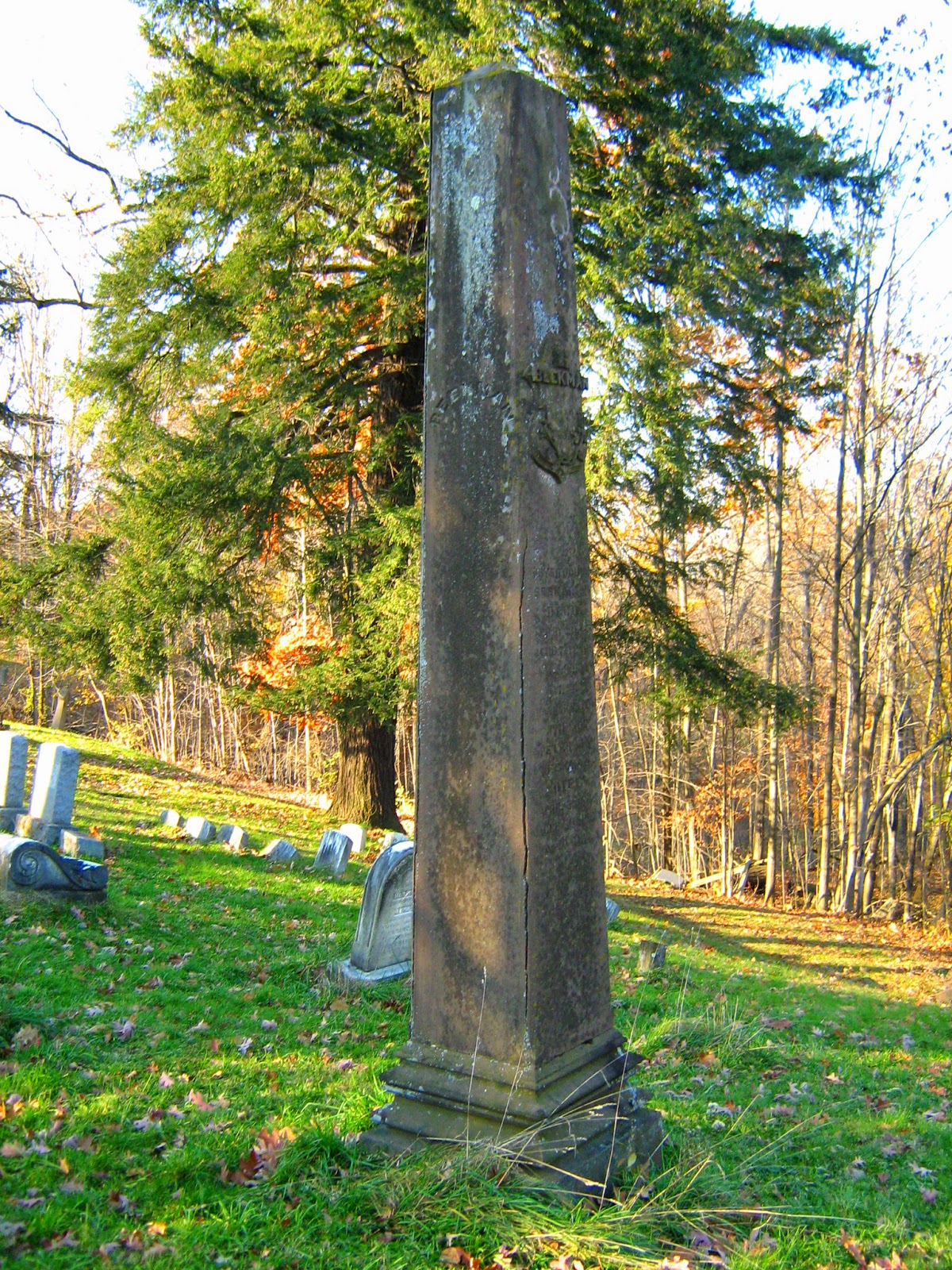
A sandstone shaft on the Middle Ridge just down the road from the Delavan family lot marks the grave of Peter Douw Beekman.  A veteran of the Revolutionary War who later served as a justice of the peace, Beekman was born in 1762 and married Hannah Hilton.  The couple lived in Albany on Van Schaick Street, a short street that ran between Fox Street (now Sheridan Avenue) and Orange Street.  The home overlooked the Vozenkill, also known as Fox Creek and now buried under Sheridan Avenue.  

When he died in 1835, he was buried in the Dutch Reformed section of the State Street Burying Grounds where several of his children who had predeceased him were already laid to rest (including two unmarried daughters Phebe who died in 1819 at the age of 20 and Elizabeth who died in 1823 at the age of 32).  These graves were removed from the Burying Grounds to Albany Rural Cemetery well in advance of the general disinterment in the late 1860s, probably after the death of his widow, Hannah, in 1849. This family's burials don't appear in the Cemetery's index card files, a common case with these older reinterments.

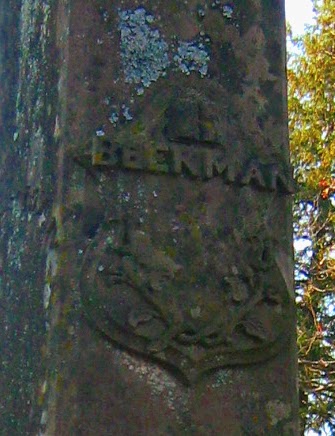
The sandstone shaft may be the original monument brought over from the burial grounds.  The front of the shaft has a carved shield with the family name.  Above the name is an open book, probably representing the Bible or symbolic of wisdom.  Below it is a garland of woody stems ending with tulip-like buds.


Monday, January 19, 2015

Francis E. Cornwell


This weathered little stone on the Middle Ridge records that Francis E. Cornwell died in Buffalo on November 2, 1869 at the age of forty-seven.  The Biographical Record of Yale University's Class of 1842 gives a detail account of his life and death.

Born in New Britain, Connecticut to Deacon Chauncey Cornwell and Mary Cosslett Cornwell, he came to Albany as a teacher shortly after graduating from Yale.  He relocated to Lyons in Wayne County where he studied law.  He was admitted to the bar in 1847, the same year in which he married Albany resident Catharine Livingstone Howe.  The couple resided in Buffalo where he possessed "an excellent reputation" as a lawyer and, in 1869, was nominated for Judge of the New York State Supreme Court.  Sadly, just two weeks before Election Day, Cornwell took ill.  The local newspapers described his sickness as "typhoid fever, complicated by a dangerous carbuncle on his head."  He left behind his widow, Catharine, and six children.

He was buried in a lot belonging to his wife's family.  Catharine passed away in 1906 at the age eighty-two.  Her headstone lies next to his.


Wednesday, December 31, 2014

The House of Shelter Lot, Middle Ridge


A small gravestone that reads simply Little Willie resting against a tree just off Ravine Side Way is the only marker in this small lot belonging to the House of Shelter.  The lot is on the south side of the path and overlooks a narrow, deep section of the Moordanaers Kill ravine between the remnants of Consecration and Tawasentha Lakes.

The House of Shelter was an institution founded in 1868 with the intent of "reclaiming and reforming women who had strayed from the path of virtue and were living in vice."  The House of Shelter owned two such lots at the Rural Cemetery.  There is a much larger one overlooking an overgrown area between Sections 104 and 121.

There are forty-six recorded burials in the House's Middle Ridge lot.  The earliest was in 1875 and the latest was in 1889.  There are also three burials for which no date is listed.  Of the forty-six burials here, most were children less than two years of age.

The sole headstone here may have marked the grave of one of three infants named Willie who were buried here:  Willie Critz (died June 1, 1765 - the first burial in the lot), Willie Gray (died July 20, 1877), and Willie Fry (died June 12, 1885).  The stone is undated and has no last name so it is not possible to further identify Little Willie.

Tuesday, November 11, 2014

Solomon Van Rensselaer

Solomon Van Rensselaer's tall marble monument is perched on a slope overlooking Ravine Side Way, a path that begins near the remains of Consecration Lake and runs parallel to the Middle Ridge Road at the top of the same slope.  Since it overlooks this somewhat secluded walk and faces away from the main road, it's fairly easy to miss.  Two of the early histories of the Rural Cemetery - Henry Phelps' The Albany Rural Cemetery - Its Beauties, Its Memories and Edward Fitzgerald's Handbook For The Albany Rural Cemetery - both make substantial mention of this grave site.

Solomon Van Rensselaer was, among other things, a soldier, a U.S. Congressman, postmaster of Albany, and owner of Cherry Hill which had been built by his father-in-law.  He is perhaps best known, though, for his service during the War of 1812.  Serving under his cousin, General Stephen Van Rensselaer III, he took part in the Battle of Queenstown Heights.  During the American defeat there, he was said to have been "riddled" with shots.

He died at the age of seventy-seven on April 23, 1852.  His wife, Harriet, had passed twelve years earlier.  They were originally buried in the Dutch Reformed Church's cemetery (part of the old municipal burial grounds), but were later moved to this large family plot on the Middle Ridge.  However, several newspaper clippings from the 1960s identify his original resting place as Capitol Park where Colonel John Mills was also buried for a time.

More on Solomon Van Rensselaer


Friday, September 19, 2014

The Boyd Family


When this impressively tall white marble shaft was raised, it was at the very edge of the Albany Rural Cemetery.

At the time, the Rural Cemetery had only been open for two years and this lot on the Middle Ridge was close to its western boundary.  A map published that same year shows the section was then called Wildrose Bank;  at the time, the sections were known by such fanciful names as Kelpiesford, Songbird's Bower, and Poetry Glen.  Later, the Church Grounds would be laid out just beyond this point and a lodge built here.

Before the Rural Cemetery was founded, most residents of Albany were laid to rest in the municipal State Street Burying Grounds.  Once the new Cemetery was consecrated in 1844, however, there was increasing interest in closing the old municipal graveyard and removing its burials.  By the end of the Civil War, the City's Common Council had begun that process in order to redevelop the old Burying Grounds into a public park. 

Some families, however, didn't wait for the City to disinterred their dearly departed en masse.  They made their own arrangements to have their loved ones' graves removed to newly purchased lots at the Rural Cemetery.

James and Peter Boyd, sons of a prominent Albany brewer also named James Boyd, purchased this lot in 1846.  That June, the remains of their parents and six siblings were exhumed from their graves in the First Presbyterian section of the State Street Burying Grounds, an event noted on the monument itself.  A month later, they were laid to a final rest on Wildrose Bank.  Also buried with them was Peter Boyd who himself passed away just before the re-interment.


James Boyd (the elder) was born in Scotland, but settled in Albany before the Revolutionary War.  In 1776, he married another native of Scotland, Jane McMaster.  In 1796, he founded the Arch Street Brewery (later known as the Albany Breweing Company) on a site near South Pearl Street and the outlet of the Beaverkill.   He died in 1832.

Another member of the Boyd family is buried just down the Middle Ridge Road beneath a large and elaborate monument.


Wednesday, April 2, 2014

Charles and Blandina Dudley


This tall, slender brownstone spire on the Middle Ridge stands on the Middle Ridge just a few yards from the Burden crypt.  From this high vantage point, one can look down over Cemetery's chapel and across the Hudson River or down into the south ravine to see the remnants of the cascades and Consecration Lake.

This monument, erected by the widowed Blandina Bleecker Dudley, is also a treasury of local history and family pride.  All of its flat faces are carved with detailed inscriptions which proudly chronicle such details as colonial emigrations and the original burial places of the remains transferred here by Blandina.

Among those buried here are Anneke Janse Bogardus, (the17th-century widow who owned a large tract of what is now Manhattan), Harmanus Bleecker (a member of Congress and namesake of the former library on Washington Avenue and Dove Street), and Jan Janse Bleecker (the blacksmith who came here from Holland in 1658).

Born in 1783, Blandina (spelled Blandena on the Cemetery's records) was the daughter of Rutger Bleecker, a Revolutionary War gunsmith who made a considerable fortune in speculating on land seized from Tories.  Her English-born husband, merchant Charles Dudley, had a distinguished politcal career; he served as Mayor of Albany from 1821-4, New York State senator from 1823-25, a second term as Mayor from 1828-9, and United States Senator from 1829-31.

His inscription on the spire reads:

Charles Edward Dudley Born May 23rd 1780 at Johnson Hall, Stafford-Shire, England.  Baptized in the Parish Church of Eccleshall by the Rev Dr Catlow.  Departed this life Jan 23rd 1841 at his residence in the City of Albany with all the Christians Blessings, beloved, and Honoured by all.  He has exchanged his mansions on earth for a more enduring one in Heaven in the Hope of a Blessed Immortality.  Erected by Blandina Dudley relict of Charles Edward Dudley, A.D. 1854.  Mary Ann only sister of Charles Edward Dudley Died Dec 17 - 1806 at New York aged 23 years  Her remains were placed under the Old Dutch Church now Post Office, N. York

Charles and Blandina had no children to inherit the family money.  To honor her husband and leave a permanent legacy, Blandina donated a generous portion of his estate (equivalent to $3 million in today's money) which would establish the Dudley Observatory.

Created by a state charter in 1852, the first observatory was built two years later just north of Albany on what is still called Dudley Heights.  However, the vibrations of trains passing too close to the original site were harmful to the sensitive instruments houses at the original observatory.  A new Dudley Observatory was built on South Lake Avenue in the early 1890s.  The Dudley Observatory is now located at 15 Nott Terrace in Schenectady (though, as noted on Wikipedia, it no longer serves as an active astronomical observatory) and is now part of the Museum of Science and Innovation (miSci).

Blandina died on March 6, 1863.  Her inscription on the grand family monument is much shorter than her husband's:

Blandina Bleecker Relict of Charles E. Dudley Born Oct. 1, 1783, Died March 6, 1863.  Aged 80 years & 5 months.  

The Dudley Observatory homepage.

Sunday, November 3, 2013

James Eights

James Eights's watercolors are among the few visual records of early 19th-century Albany.  Painted in the 1840s, the pictures illustrate the city as it appeared in 1805 (and, in some cases, earlier).  Eights worked not only from his own memory, but from maps, documents, and personal recollections of locals.

Eights was born in Albany in 1798 to Dr. Jonathan Eights and his wife, Alidea Wynkoop.  His maternal grandfather, Jacobus Wynkoop, was a skipper, boatbuilder, and veteran of the Revolutionary War.   Jacobus reportedly built the sloop Experiment which was famous for its 1786 voyage to China.

As a young man, James Eights was appointed as a draftsman working on the geological surveys made for the construction of the Erie Canal.  By 1829, he was at sea as a surgeon and naturalist on a voyage to Antarctica.  Despite publishing his accounts of the voyage and the later naming of the Eights Coast in his honor, he was not a member of a follow-up expedition to the Southern Hemisphere, apparently as a result of the same alcoholism which would leave him broke later in life.

He returned to Albany in 1830 to live with his parents and, in the 1840s, began work on his series of paintings of his native city.  An excellent visual comparison of his historic views with the present can be found here.  In addition to painting, he wrote and published a number of reports on geology and history.

Unmarried and destitute, James Eights moved to his sister's home in Ballston Spa where he died of Bright's Disease on June 22 1882.  He was eighty-four years old.  Two days later, he was buried in his family's plot on the Middle Ridge.  The eastern face of the monument bearing his name is rather worn and difficult to read, but his parents' names on the north face of the marble are fairly legible.


Tuesday, October 15, 2013

Lawson Annesley

 
The Annesley family plot on the Middle Ridge is marked with a tall, simple granite shaft marked with an elegant letter "A."

The most notable grave in this lot is that of Lawson Annesley (1795-1865), a well-known dealer in mirrors, picture frames, and art.  He was a friend of sculptor Erastus Dow Palmer and his shop and gallery became a gathering place for Palmer and other prominent local artists of the era.


The facade of Annesley's Ten Broeck Street home still stands.

Tuesday, April 9, 2013

Kate Stoneman

Kate Stoneman's granite headstone stands on a slight rise above the footpath running along the south side of the Middle Ridge. In front of the monument is a bronze plaque which gives a short history of New York's first female member of the Bar.

Kate Stoneman was the first woman admitted to practice law in New York State.  After training in a private firm, her application to join the Bar was rejected because of her gender.  She then successfully campaigned to amend the Code of Civil Procedure to permit the admission of qualified applicants without regard to gender or race.  Her admission to the NYS Bar in 1886 paved the way for thousands of women and minorities who followed.  Ms. Stoneman continued her legal education by attending Albany Law School and, in 1898, became the first woman to graduate.

Albany Law School celebrates Kate Stoneman every April and maintains an informational site about her.


Monday, April 1, 2013

The Burden Vault


In a cemetery filled with beautiful monuments and vaults, the Burden vault is one of the most spectacular. 

Henry Burden was one of the area's best known industrialists and its said he selected this spot on the east slope of the Middle Ridge because, from here, one could look across the Hudson River and see his Iron Works with its massive waterwheel. 

Just opposite the vault is a large marble book.  On its open pages, there are lengthy inscriptions in honor of Henry Burden and his wife, Helen.

SACRED TO THE MEMORY OF HENRY BURDEN
He was born in Stirling Shire, Scotland, April 22nd, 1791.  Died, Troy, Jan. 19th, 1871.  Endowed by Providence with an intellect marked by strength and originality, he early evinced a taste for the study and application of the forces of Nature and became the author of several mechanical inventions, which have served to lighten human toil and promote human happiness.  The results of his creative genius are known in all parts of the civilized World, and have secured him a place among the Benefactors of the Race.  Commanding in person:  Honest in his dealings with his fellowmen:  Affable in social life:  Liberal in his benefactions:  Refined and loving in his family, with a simple Faith in the Redeemer, he closed his useful life on Earth and entered into the Rest which remaineth for the people of God.

SACRED TO THE MEMORY OF HELEN, WIFE OF HENRY BURDEN
She was born in Stirling Shire, Scotland, Febr'y 13th, 1803, and died in Troy, March 10th, 1860.  Noble in person:  Refined in manners:  Prudent in counsel:  Faithful in friendship:  Generous in benevolence:  Sincere in religion:  With all the virtues in happy combination.  She beautifully adorned the relation of Daughter, Sister, Wife, and Mother, and has left an example worth of study and imitation.
“A perfect woman nobly planned –
To warn, to comfort, and command;
And yet a spirit still and bright
With something of angelic light –“
Her children rise up and call her blessed; and her husband also, and he praiseth her.
   

The vault was built in 1850 and some of the early histories of the Cemetery attribute the design to Helen Burden herself.  The ornate facade includes a woman's face above the door; it's said to be an idealized portrait of Helen herself.  The dogs atop the vault were modeled after family pets.

One can peek around the wooden panel covering the iron gate and see the marble-covered burial niches of Henry, Helen, and other members of the Burden family.

Wednesday, March 27, 2013

Idol of His Command

The grave of Colonel Walter A. Van Rensselaer (1836-1879) is set into the slope of the Middle Ridge just above the Burden family vault (one of the sculpted Burden dogs can be seen in the background on the left). 

A descendent of two of Albany's most prominent families - the Van Rensselaers and the Schuylers, - he served with the 20th NY Militia and was wounded in the neck during Pickett's Charge at Gettysburg.  An 1858 graduate of Albany Medical College, he became a physician after the war. 

The inscription on his simple granite headstone reads:  Idol of His Command, Chosen Comrade of His Peers, Pet of His Superiors.

Tuesday, February 26, 2013

Captain Samuel Schuyler

This towering marble monument with anchors carved on both its east and west faces stands on the brow of the Middle Ridge with a commanding view of the Hudson River and valley below.

Anchors on headstones often represent steadfast faith and are found on a number of graves in Albany Rural Cemetery.  In this case, they also symbolize the occupation of the deceased (such as the Bogart and Townsend monuments)

He was born in 1781, but very little is known of Samuel Schuyler's origins, though it has been speculated that he was a descendent of the prominent Albany family of the same name.  Sometime prior to 1805, he married Mary Martin-Morin; the couple would have eleven children.

Like many other African-Americans of his era, Samuel began his working life as a laborer on Quay Street, along Albany's thriving waterfront. Within five years of his marriage, though, he had his own boat to haul lumber, produce, and other goods. He would expand his business interest to real estate, owning a substantial number of lots along South Pearl Street.  His sons would join him in business, as partners in a flour and feed store and, later, they would establish the Schuyler Towboat Company.

Captain Schuyler died in 1842 and was buried in this lot which also holds the graves of three generations of his family.  It's interesting to note that, when his son and namesake died in 1894, the New York Times obituary made no mention of the family's African-American heritage and referred to his ancestors as "the early Dutch settlers of Albany." 


Sunday, February 24, 2013

The Meads Monument

This marble monument stands in the Meads family plot on the Middle Ridge, close to the Young double headstone and Erastus Palmer's monument for Lucia Olcott.

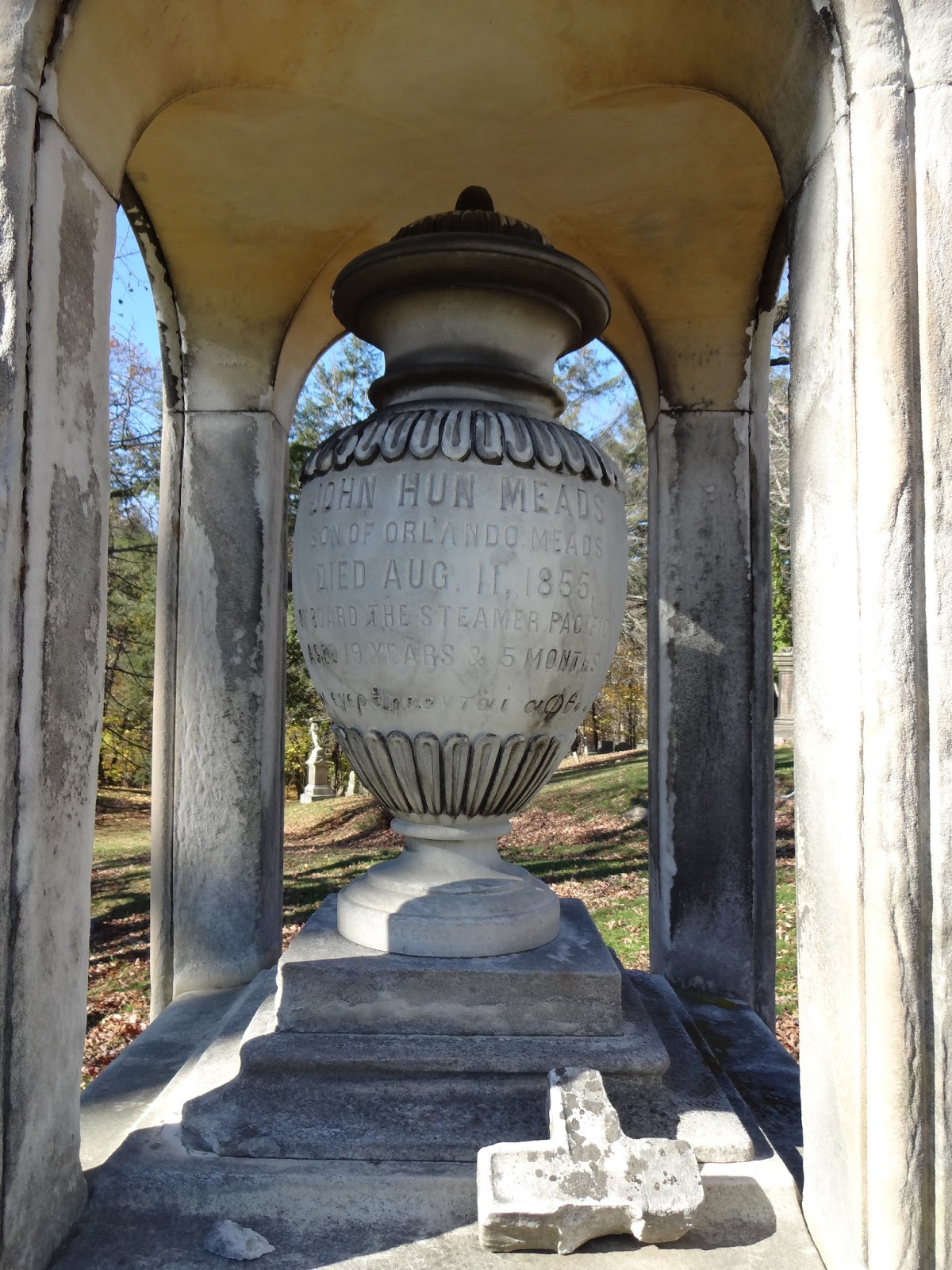
The monument consists of a urn enclosed within a marble canopy.  The cross which once topped the monument has fallen off and rests by the urn.  It marks the graves of several members of the family of Orlando Meads (a founding member and later president of the Albany Institute), most notably his son.

The inscription on the urn reads:

John Hun Meads Son of Orlando Meads Died Aug. 11, 1855 On Board The Steamer Pacific Aged 19 Years & 5 Months.  

There is also a inscription in Greek.   Near the base of the urn, is the notation "Buried In Albany" which hints that the urn may have been created first as a memorial to the young man and located elsewhere before being placed in the Cemetery.  His father, Orlando, served as president of the Albany Institute of History & Art. 

An inscription on the front of the monument bears the name of another John Meads who died  in 1870.  According to Henry Phelps' history of the Cemetery, John Meads was a great admirer of the Rural Cemetery who visited almost daily.  The Fitzgerald guide to the Cemetery describes him as "an old and respected citizen of Albany, who was conspicuous in many noble public charities."