There is a family plot perched somewhat precariously on the Middle Ridge hill just above the Ozia Hall monument and not too far from the Samuel Schuyler lot. From the path below, it appears to be just a row of granite urns facing a tall, but otherwise unassuming marble shaft. From the hill above, though, a set of old flat gravestones can be seen laid between the granite urns and the marble shaft.
The shaft reads simply The Family of The Souldens. One of the headstones has a very simply carved hand with its index finger pointing toward heaven. Another stone is a very pleasant discovery; a plump, winged cherub's head framed by a lozenge and flanked by daisies finials.
The lot was deeded to an Englishman named William Soulden who was interred there in 1851, just seven years after the Cemetery opened. Several of the gravestones in the lot predate the Cemetery and were likely moved here from the State Street Burying Grounds by Soulden.
Those interred in this lot include:
Sarah A. Smith, died September 7, 1825, age 88
Catherine Eliza Soulden, died February 24, 1831, age 9
William M. Soulden, died October 23, 1835, age 19
Catherine Townsend, died May 18, 1849, age 70
Ann M. Soulden, died August 9, 1849, age 32
Louisa B. Muir, died August 13, 1849, aged 32
William Soulden, died August 21, 1851, age 64
Ann M. Soulden, died November 16, 1860, age 80
The burial cards on file unfortunately provide no other details, a common occurrence with some of the older records or relocated graves.
The family had a connection to one of Albany's oldest and well-known buildings, a brick mansion built on Washington Street for Samuel Hill (who is buried in the Cemetery's Church Grounds section) and attributed to architect Philip Hooker. Documentation for the National Register of Historic Places gives some details:
"In 1820, the property was acquired by Sarah Smith, a widow, and her niece, Catherine Townsend and the Albany City Directories list Mrs. Sarah Smith as living in Hill's Mansion House on Washington Street. In 1821, William Soulden is also listed as an occupant. The Townsend-Soulden family operated the large property as a boarding house, with Aaron Burr having been among their guests in 1824. When Sarah Smith died in 1825, she bequeathed the house to Catherine Townsend and William Soulden, in trust for another neice, Ann Maria, the wife of Soulden. William and Ann Soulden owned the property until 1827."
The house in question still stands on Washington Avenue and is quite familiar to many as the Fort Orange Club.
Showing posts with label relocated graves. Show all posts
Wednesday, February 25, 2015
Friday, February 6, 2015
Peter Douw Beekman
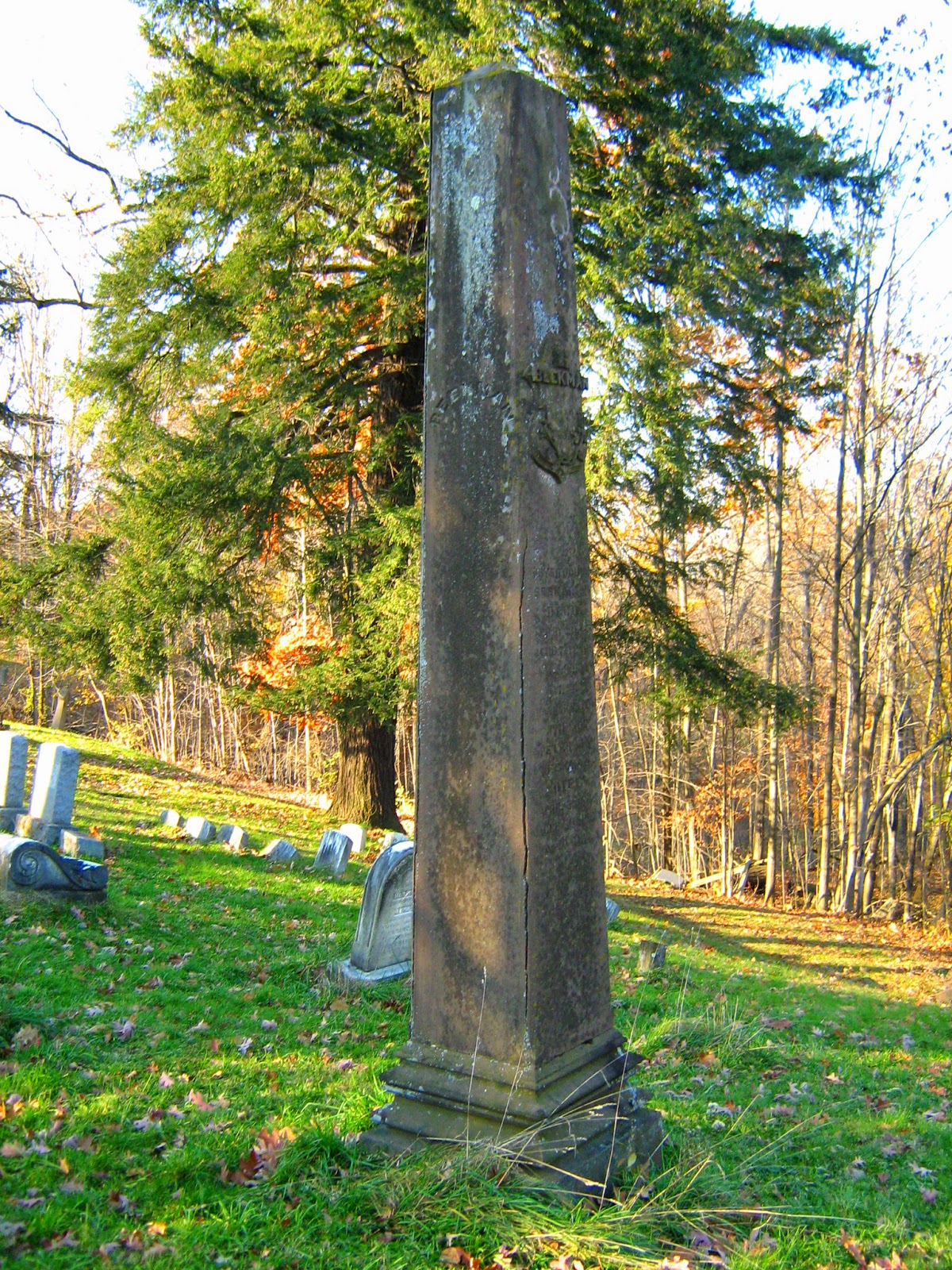
A sandstone shaft on the Middle Ridge just down the road from the Delavan family lot marks the grave of Peter Douw Beekman. A veteran of the Revolutionary War who later served as a justice of the peace, Beekman was born in 1762 and married Hannah Hilton. The couple lived in Albany on Van Schaick Street, a short street that ran between Fox Street (now Sheridan Avenue) and Orange Street. The home overlooked the Vozenkill, also known as Fox Creek and now buried under Sheridan Avenue.
When he died in 1835, he was buried in the Dutch Reformed section of the State Street Burying Grounds where several of his children who had predeceased him were already laid to rest (including two unmarried daughters Phebe who died in 1819 at the age of 20 and Elizabeth who died in 1823 at the age of 32). These graves were removed from the Burying Grounds to Albany Rural Cemetery well in advance of the general disinterment in the late 1860s, probably after the death of his widow, Hannah, in 1849. This family's burials don't appear in the Cemetery's index card files, a common case with these older reinterments.
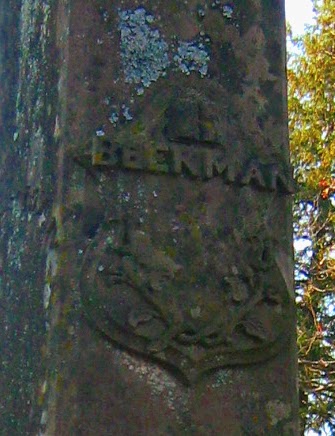
The sandstone shaft may be the original monument brought over from the burial grounds. The front of the shaft has a carved shield with the family name. Above the name is an open book, probably representing the Bible or symbolic of wisdom. Below it is a garland of woody stems ending with tulip-like buds.
Monday, September 22, 2014
Pye The Englishman
Around 1800, an Englishman named John Pye opened a tavern on the road between Albany and Troy. It stood just a little south of the present entrance to the Rural Cemetery along Route 32.
Born in England around 1752, he first appears in local records after the end of the Revolutionary War and was known to be a good friend of General Philip Schuyler and his family. The Schuylers were, of course, his neighbors; their large farm known as The Flatts lay just a few yards northwest from the Pye Tavern.
John Pye is best remembered for a robbery at his tavern on a wintery night in 1808. Robert Johnson, later described as "a highwayman," entered the tavern seeking $1,000 in cash and gold that Pye was rumored to have beneath his bed. He surprised the sleeping innkeeper and his wife and, drawing a pistol, demanded, "Your money or your life." When Pye hesitated, Johnson fired and wounded him in the neck. Some accounts say that Pye's wife, Elizabeth, then fired at the highwayman with her husband's own pistol.
Johnson fled, racing back to Albany on horseback. He attracted attention when he jumped his horse across a toll barrier and escaped across the river. By then, the alarm had been raised and William Winne, a letter carrier and watchman pursued the highwayman through the snow. When Winne confronted Johnson, the robber pulled a knife on him and managed to knock out Winne's front teeth. Winne, however, was able to subdue him by seizing his bandana and choking him with it. Johnson was apparently wounded by Mrs. Pye's shot and died shortly after being taken into custody. His skeleton was reportedly kept in the office of an anatomist in Troy for some years after.
John Pye survived the attack and continued to manage his tavern. The incident caused quite a sensation in the local papers and an account was published in 1836 with the lengthy title, "The robber, or A narrative of Pye and the highwayman, Being a detailed and particular account of an attempted robbery of the inn of John Pye, between the cities of Albany and Troy, N.Y. in 1808, and of the outlaws' final capture and end: as related by Mrs. Pye herself, and others who were most intimately acquainted with the whole tragical affair..." The story was not without embellishments, some contributed by William Winne himself.
Pye died in 1817 and was buried among his friends in the Schuyler family burial ground at The Flatts. His widow married their bartender, William Nutt, and continued to manage the tavern. She died in 1846 at the age of 90 (or 97, according to some sources). She and her second husband were also buried at The Flatts.
In the 1920s, all of the graves at old Flatts burial ground was removed to the Rural Cemetery. A number of headstones were brought over from The Flatts with the remains, but most are now illegible. One of the worn stones above may be that of Pye The Englishman.
More on the original Flatts burial ground here.
Born in England around 1752, he first appears in local records after the end of the Revolutionary War and was known to be a good friend of General Philip Schuyler and his family. The Schuylers were, of course, his neighbors; their large farm known as The Flatts lay just a few yards northwest from the Pye Tavern.
John Pye is best remembered for a robbery at his tavern on a wintery night in 1808. Robert Johnson, later described as "a highwayman," entered the tavern seeking $1,000 in cash and gold that Pye was rumored to have beneath his bed. He surprised the sleeping innkeeper and his wife and, drawing a pistol, demanded, "Your money or your life." When Pye hesitated, Johnson fired and wounded him in the neck. Some accounts say that Pye's wife, Elizabeth, then fired at the highwayman with her husband's own pistol.
Johnson fled, racing back to Albany on horseback. He attracted attention when he jumped his horse across a toll barrier and escaped across the river. By then, the alarm had been raised and William Winne, a letter carrier and watchman pursued the highwayman through the snow. When Winne confronted Johnson, the robber pulled a knife on him and managed to knock out Winne's front teeth. Winne, however, was able to subdue him by seizing his bandana and choking him with it. Johnson was apparently wounded by Mrs. Pye's shot and died shortly after being taken into custody. His skeleton was reportedly kept in the office of an anatomist in Troy for some years after.
John Pye survived the attack and continued to manage his tavern. The incident caused quite a sensation in the local papers and an account was published in 1836 with the lengthy title, "The robber, or A narrative of Pye and the highwayman, Being a detailed and particular account of an attempted robbery of the inn of John Pye, between the cities of Albany and Troy, N.Y. in 1808, and of the outlaws' final capture and end: as related by Mrs. Pye herself, and others who were most intimately acquainted with the whole tragical affair..." The story was not without embellishments, some contributed by William Winne himself.
Pye died in 1817 and was buried among his friends in the Schuyler family burial ground at The Flatts. His widow married their bartender, William Nutt, and continued to manage the tavern. She died in 1846 at the age of 90 (or 97, according to some sources). She and her second husband were also buried at The Flatts.
In the 1920s, all of the graves at old Flatts burial ground was removed to the Rural Cemetery. A number of headstones were brought over from The Flatts with the remains, but most are now illegible. One of the worn stones above may be that of Pye The Englishman.
More on the original Flatts burial ground here.
Friday, September 19, 2014
The Boyd Family
At the time, the Rural Cemetery had only been open for two years and this lot on the Middle Ridge was close to its western boundary. A map published that same year shows the section was then called Wildrose Bank; at the time, the sections were known by such fanciful names as Kelpiesford, Songbird's Bower, and Poetry Glen. Later, the Church Grounds would be laid out just beyond this point and a lodge built here.
Before the Rural Cemetery was founded, most residents of Albany were laid to rest in the municipal State Street Burying Grounds. Once the new Cemetery was consecrated in 1844, however, there was increasing interest in closing the old municipal graveyard and removing its burials. By the end of the Civil War, the City's Common Council had begun that process in order to redevelop the old Burying Grounds into a public park.
Some families, however, didn't wait for the City to disinterred their dearly departed en masse. They made their own arrangements to have their loved ones' graves removed to newly purchased lots at the Rural Cemetery.
James and Peter Boyd, sons of a prominent Albany brewer also named James Boyd, purchased this lot in 1846. That June, the remains of their parents and six siblings were exhumed from their graves in the First Presbyterian section of the State Street Burying Grounds, an event noted on the monument itself. A month later, they were laid to a final rest on Wildrose Bank. Also buried with them was Peter Boyd who himself passed away just before the re-interment.
James Boyd (the elder) was born in Scotland, but settled in Albany before the Revolutionary War. In 1776, he married another native of Scotland, Jane McMaster. In 1796, he founded the Arch Street Brewery (later known as the Albany Breweing Company) on a site near South Pearl Street and the outlet of the Beaverkill. He died in 1832.
Another member of the Boyd family is buried just down the Middle Ridge Road beneath a large and elaborate monument.
Tuesday, November 20, 2012
The Young Double Stone
This stone, lying flush with the earth on the Middle Ridge, is one of the most distinctive. Cut from a dull blue-gray slate, this double stone features two wonderful examples of New England gravestone art and has an interesting family story as well.
The stone was carved by William Young, known to gravestone historians as "the thistle-carver" since he often incorporated that plant into his designs. This stone does not include any thistles, but does feature a pair of William's distinctive bewigged heads with their prominent noses, small mouths, and staring eyes. William's work was almost exclusively confined to the area around Worcester, Massachusetts so finding one such as this here in New York is extremely unusual. In fact, a bit of carving at the bottom of the stone indicates that this was actually removed from Worcester in the early 1870s.
This stone was carved by William Young to mark the graves of his father and grandfather, originally located in Worcester's Commons burial ground. The neatly lettered inscription reads:
Here lyes interred the Remains of John Young who was born in the Isl of Bert near Londonderry in the Kingdom of Ireland. He departed this life June 30th, 1730, aged 107.
Here lyes interred ye Remains of David Young, who was born in the Parish of Tahboyn, County of Donegall & Kingdom of Ireland. He departed this life Decemb'r 23rd, 1776, age 94.
As one can see from the inscription, John Young and his son David lived exceptionally long lives.
John Young immigrated from Ireland to Massachusetts at the age of ninety-five, bringing with him a family that included his son, David, and David's son, William. The Young family settled near Worcester as farmers, but William would later be described as gentleman squire. Well read, his personal library included six law books, six history books, six science books, eighteen on religious matters, one of poetry, and seven school texts. He would serve as the town Surveyor and a Justice of the Peace. Carving gravestones was apparently only a side job for him, but he was certainly an active carver; the Farber Gravestone Collection contains photographs of numerous stones attributed to him, including the John and David Young double stone.
The John & David Young stone in the Farber Gravestone Collection
The Young monument came to Albany Rural Cemetery in 1873 when a descendent had it removed to a family plot here. Unfortunately, when the stone was removed from its original site, the homespun epitaph at the bottom - presumably composed by William - was cut away. The missing portion once read:
The aged Son and the more aged Father Beneath this stone their mouldering bones here rest together.
Thursday, October 25, 2012
The Grave of The Bridgens
This worn and mossy marble stone is set high on a hill near the path leading past the Appleton lot to the little bridge which crosses Moordenaers Kill to connect the South Ridge with the western end of the Middle Ridge. Also set into this hillside are the vaults of the Pumpelly-Read, Stanford, and Pester-Osterhout families.
This stone reads simply Grave of The Bridgens.
Fitzgerald's 1871 Handbook For The Albany Rural Cemetery describes this somewhat obscure monument:
If we look sharply we will see...a low block of marble inscribed "The Grave of The Bridgens," and some distance back of it a single undecorated grave. The simple quaintess of the inscription has provoked many a query, and yet there is nothing cabalistic in it. The grave contains the reinterred remains of several members of the Bridgen family.
Only a Thomas Atwater Bridgen, an attorney, appears in the inventory of graves moved from the old State Street Burying Grounds to the Rural Cemetery's Church Grounds. He is among those buried beneath this unusual stone.
Subscribe to:
Posts (Atom)