Showing posts with label marble monuments. Show all posts

Tuesday, June 9, 2015

A Sweet Surprise


As mentioned in a previous post, the Rural Cemetery has been full of surprises this spring.  As I stopped to take a picture on the North Ridge near the Kreuder monument, I noticed something different set against the trees at the edge of the ravine.

From a distance, it was actually difficult to tell just what was set atop this tall monument.  At first, it appeared to be a large bird, but it was too still and lacked the coloring of the hawks which are fairly common here.  It might have been a simple draped urn or even a statue.  Upon a closer look, it turned out to be the latter.

It's located not too far from the Hallenbake lot and the little headstones of the Prentice daughters.  It was also mentioned in Henry Churchill's 1858 Guide Through The Rural Cemetery.  Yet, somehow, I'd never seen it before.  Perhaps because, the last time I was close to it, I was limping along with a cane and, on previous wanderings, I was too busy picking my way down the marble steps that lead from the Hallenbake enclosure to the old, narrow path that runs along the north shoulder of the ravine.

One reason it's easy to miss is because it was meant to be seen from that path, identified on older maps as Dell Side Avenue.  It faces the ravine and, when the old bridges which linked the North, Middle, and South Ridges, there would have been several scenic approaches to this lot.  From the lot, there would have been a lovely view of the Kromme Kill and Indian Lake.


The little statue atop the monument turned out to be quite familiar.  I've seen examples of this kneeling child before.  There is a similar one in Schenectady's Vale Cemetery and other copies appear in burial grounds around the country.  A similar figure also appears as a stock image in old advertisements for stonecutters such as William Manson and James Gazeley. 

A check of burial records shows that this is the Anderson family monument and there's the sweet aspect;  the Andersons were in the candy business.  A city directory from 1848 lists George Anderson as a "Plain and Ornamental Confectioner" at the corner of Broadway and Lydius Street (now Madison Avenue).  The advertisement offers various sweet goods such as ice cream, jellies, cakes, and pastries.  A few years later, the 1853 directory featured a full page advertisement for Anderson & Wright, a well-stocked candy "manufactory" and soda foundation.

George Anderson was born in England around 1818.  His burial records state he died of consumption on March 11, 1856.  His widow, Sarah, was born in Berne, New York in 1820.  She passed away on Christmas Eve, 1879.  About a dozen other family members are interred around this lot, including George's siblings, Charles and Mary Anderson.  Charles and Mary both died of consumption within days of each other;  thirty-five year Charles on March 8, 1844 and twenty-nine year old Mary on March 14, 1844 died on March 8, 1844.  The Rural Cemetery had not yet been consecrated so Charles and Mary were temporarily interred at the State Street Burying Grounds as their burial records indicate that they were "removed from Albany" to this lot.
 The ad above is borrowed from the Albany...The Way It Was image collection on Flick.

Wednesday, April 3, 2013

Then & Now - The Howe-Robinson Lot

Edward Fitzgerald's 1871 Handbook For The Albany Rural Cemetery describes monument as a very striking little structure of polished Scotch granite surmounted by a chaste marble figure...one of the most delightful little specimens we have yet seen.  The admiration it receives is partly due to the fact that it embodies that highly appropriate ideal for a cemetery memorial - Remembrance.  The darker color of the polished pedestal gives pleasing prominence to the pure white marble figure, so sweet in expression, graceful in form and pose, and perfect in finish.

The monument stands on the South Ridge, just north of the Van Rensselaer lot and close to the enclosed lot of William James' family.  The statue which elicited such enthusiasm from Fitzgerald is surrounded by small granite headstones, each carved with a stylized floral motif.

The graves of Silas B. Howe and his wife, Eliza, are located on the south side of the lot.  A city directory for 1844 lists Howe as a draper at 28 Division Street.  He died in 1869 in New York City at the age of sixty-four and Joel Munsell noted his passing in Collections On The History of Albany.

Silas Howe will long be remembered for his genial and catholic spirit, and friendly disposition.  His ear and heart were always open to the needy, and of his means, those who knew him best, were well aware that he bestowed with liberality, even perhaps to a fault.

The 1850 census lists Howe's household as the following:  Silas B. (44), Eliza (38), Benjamin (14). Alexander (8), Margaret (4).  Also listed in the same household are Samuel Robinson (32), Margaret Robinson (36), Alexander Lloyd (45), and a servant from Ireland, Bridget Howard (25).  Alexander was Margaret's older brother.

Samuel Robinson and his wife, Margaret, are buried on the east side of the lot.  He died in 1876, she in 1870.
The engraving at the top of this post was published in Fitzgerald's Handbook shows the area around the monument free from any other gravestones.  This was definitely a bit of artistic license as many memorials surrounding the Howe-Robinson lot now are from the same period or earlier.

Monday, March 4, 2013

Our Darling Anna

This ornate marble monument for a little girl is part of the large McClelland family lot near the Hallenbeek enclosure on the North Ridge. The centerpiece of this lot is a large, elaborate monument crowned with a flaming urn and will be the subject of a future post.

Anna's grave has both its original headstone and footstone, though the latter was probably topped with a now-missing cross and the base of that missing ornament is now askew.  The curbing of this bed-like monument is still intact and the area enclosed by it was most likely planted with flowers at one time.  The headstone, with some nicely caved drapery over the top features a relief of the little girl as an angel carrying a banner.  The writing on the banner is too worn to read easily.


Sunday, February 24, 2013

The Meads Monument

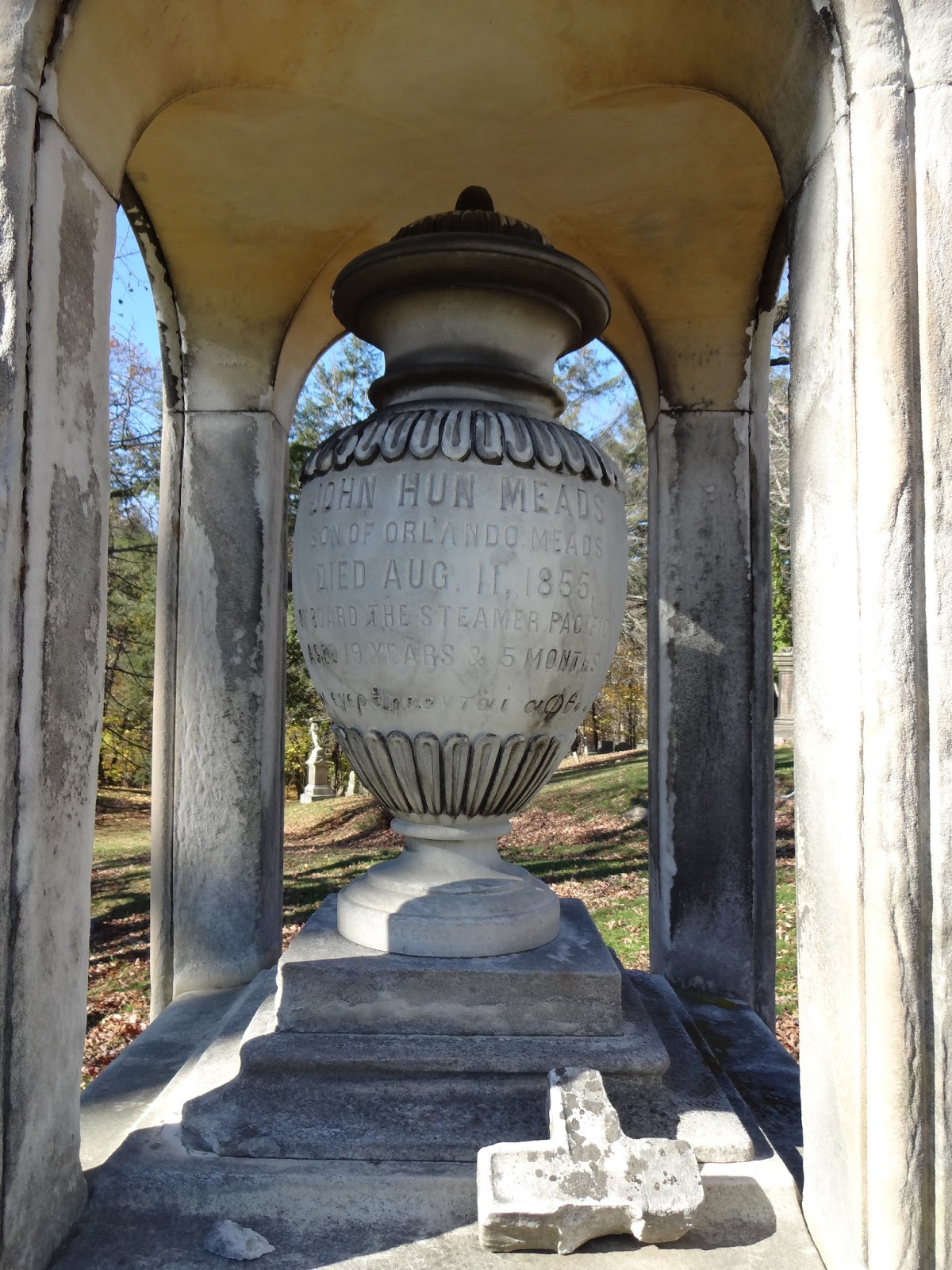
This marble monument stands in the Meads family plot on the Middle Ridge, close to the Young double headstone and Erastus Palmer's monument for Lucia Olcott.

The monument consists of a urn enclosed within a marble canopy.  The cross which once topped the monument has fallen off and rests by the urn.  It marks the graves of several members of the family of Orlando Meads (a founding member and later president of the Albany Institute), most notably his son.

The inscription on the urn reads:

John Hun Meads Son of Orlando Meads Died Aug. 11, 1855 On Board The Steamer Pacific Aged 19 Years & 5 Months.  

There is also a inscription in Greek.   Near the base of the urn, is the notation "Buried In Albany" which hints that the urn may have been created first as a memorial to the young man and located elsewhere before being placed in the Cemetery.  His father, Orlando, served as president of the Albany Institute of History & Art. 

An inscription on the front of the monument bears the name of another John Meads who died  in 1870.  According to Henry Phelps' history of the Cemetery, John Meads was a great admirer of the Rural Cemetery who visited almost daily.  The Fitzgerald guide to the Cemetery describes him as "an old and respected citizen of Albany, who was conspicuous in many noble public charities."


Thursday, October 4, 2012

Teunis Van Vechten

This monument stands so close to the edge of the Church Grounds that, at first glance, it almost seems to be a part of that section.  It is, however, a private family lot in an adjacent section.

This cross-topped spire marks the grave of Albany mayor Teunis Van Vechten and his family.  A descendent of one of Albany's oldest Dutch colonial families, he was born in 1785 and educated at Union College.  After graduating with honors, he studied law and eventually became the legal adviser to the last Patroon, Stephen Van Rensselaer during the turbulent era of the Anti-Rent Wars.  He served four terms as Mayor of Albany.  He also served on the committee organized to establish the Rural Cemetery.

He died at his home (725 Broadway) on February 4, 1859.  His wife, Catherine Cuyler Gansevoort, predeceased him in 1831.  Several of their children are also buried here.

The Van Vechtan monument is wonderfully detailed.  The white marble pedestal is embellished with a pair of large inverted torches and a graceful winged hourglass.  The cross-topped spire atop it stands on heavy lion's feet and is decorated stylized foliage and wreath of laurels.  The style is very typical of sculptor Robert Launitz and may be his work.

Monday, August 27, 2012

David Strain

The monument is a tall shaft in a corner lot at the very edge of a hill on the North Ridge.  From here, one can look down on the massive Winslow vault or out across the Hudson River towards Troy.  Near the top of the shaft is the family name "Strain."  But the inscription that makes this rather obscure monument noteworthy is near the base on the south side.  It reads FIRST INTERMENT IN THIS CEMETERY.

Tuesday, July 10, 2012

Minnie & Katie

This monument to two little girls stands on the Middle Ridge, just off the main paved road and above the western end of Ravine Side Way. 

The white marble stone features an angel standing guard over a reclining child.  The angel's head and face are badly worn (giving the figure a somewhat macabre look) and the child's legs and arm are broken.  A beautifully carved wreath of flowers encircles the name "Minnie" with the name "Katie" underneath which suggests that Minnie died first and Katie's name was added sometime later.  The lamb sleeping atop the monument seems almost to have been added later, perhaps at the time of Katie's burial.  The lamb, too, has suffered damage to its head.

Friday, June 22, 2012

Holding Hands Forever

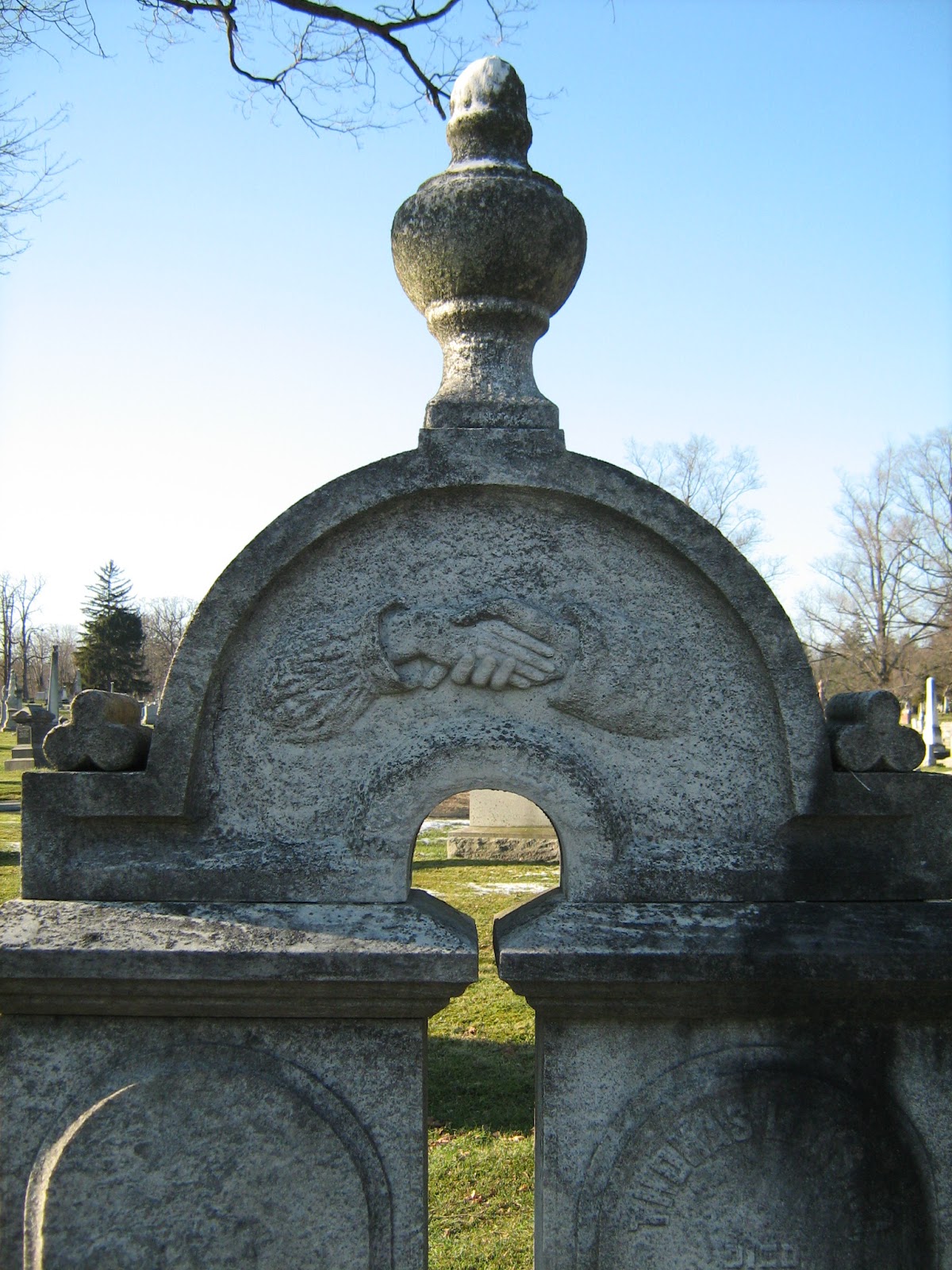
This distinctive arch-shaped monument on the North Ridge features a pair of clasped hands, a symbol found on a number of old stones throughout the Cemetery.  Showing a woman's hand and a man's, it represents marriage as the husband and wife join hands for eternity.

The pattern is repeated on the back of the monument as well, though the eastern face of the stone is a bit more worn than the western face shown above.


This monument marks the grave of several Lansings:  Jacob I. Lansing (died 1884 at age 76), his wife Mehetable (died 1877 at age 65), Myron Lansing (died 1875 at age 21) and Thomas Lansing (died in 1877 at age 56).  One tablet on the eastern side is blank.

Tuesday, June 19, 2012

The Gould Monument

 This exceptional monument is not easily spotted from the road winding up the North Ridge.  It's hidden in one of the Rural Cemetery's oldest sections on a sort of small promontory which overlooks the Winslow vault.

The monument is white marble, though much of it has turned dark gray.  The tablets on the large base are flanked by simple amphorae.  An ornate sarcophagus stands a top with an angel beside it.  One of the angel's wings is missing and its features are quite worn, giving the figure a rather ghostly look.  A scroll drapes over the corner of the sarcophagus and the angel's hand rests on it.  If anything was carved on that scroll, it's now illegible.

This monument marks the resting place of Anthony Gould and his wife, Martha Jennette.  Anthony Gould was a publisher of law books who took over the business co-founded by his brother William.  The firm operated in both New York City and Albany with the latter establishment located at 475 Broadway and then at 68 State Street.  Anthony Gould died in 1858 at the age of 55. 

According to old Cemetery maps, this section at the eastern edge of the North Ridge was known first as Kennisau Hill and, when most of the Cemetery's roads and sections were renamed, it was called Landscape Hill.

Monday, May 14, 2012

Headstones and Footstones


It's not too often that graves like this have both their coping and footstone intact.  In most cases, the coping which outlines the grave is broken or long since removed and the footstones are missing or resting against the base of the headstone. 

This grave, along the South Ridge near Little Georgie's lovely monument is surprisingly complete.  It features a beautifully carved headstone embellished with roses and a border of ivy.  The inscription reads James V.S. Teller Died September 1, 1867, Aged 87 Years.  Gone But Not Forgotten.  The ornate cross on the footstone is also embellished with flowers (though they are a bit more weathered) and monogrammed with a T on its base.

Tuesday, May 1, 2012

The Lucia Olcott Monument


This white marble monument on the Middle Ridge is an early work of Erastus Dow Palmer who is said to have designed the monument itself, as well as creating two pieces of sculpture for it.

It marks the grave of Lucia Marvin Olcott, first wife of Thomas Olcott.  Lucia died at the young age of twenty-five in 1850, two infant children having predeceased her. Thomas Olcott, one of Albany's prominent banker, was a founding member of the Albany Cemetery Association which established the Rural Cemetery and, in return for his work, was given his choice of a lot here at no charge.  Olcott himself is buried just across the path and his monument was also the work of Erastus Palmer.


The figure atop the monument is leaning over a book (which rests atop a draped urn) and presumably is inscribing the names of the deceased in this "Book of Memory."

The front of the monument features a relief which depicts a young woman, barefoot and with wings, ascending to meet to little cherubs who offer her a crown.  The soft marble has weathered and many of the details have eroded, particularly one of the winged infants and the crown.  This allegorical relief represents Lucia being welcomed to Heaven by her two children.

Saturday, April 28, 2012

The Broken Pitcher


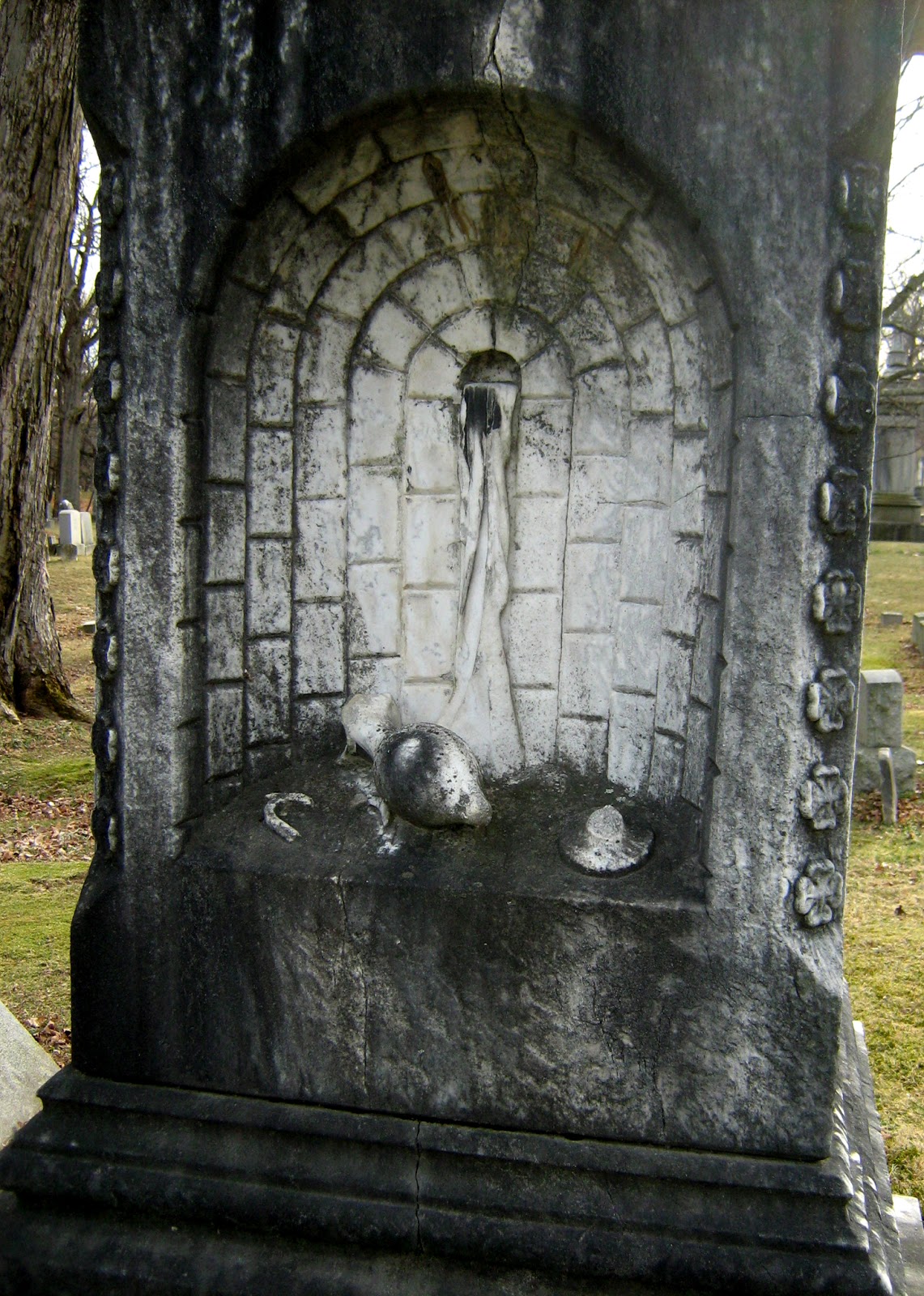
This monument, not too far from the Charles Webster obelisk on the South Ridge, has some unique imagery on its north face. 

A niche depicts a stone well with a carved cascade of water pouring down over a pitcher lying in pieces (a reference to the Old Testament's Book of Ecclesiastes).  This tall marble monument is showing many signs of wear; the stone is blackening and a long crack is visible running upwards from the well.  Above the niche is a lovely garland of carved roses (not shown here).  The style is reminiscent of some of Robert Launitz's work.

This monument marks the grave of James Morrow who died in 1859 at the age of sixty-nine.  A city business directory for 1849-50 lists a James Morrow at the corner of Broadway and Ferry Street, but does not list any occupation.