
Sunday, March 31, 2013
A Marble Lamb

Wednesday, March 27, 2013
Idol of His Command

A descendent of two of Albany's most prominent families - the Van Rensselaers and the Schuylers, - he served with the 20th NY Militia and was wounded in the neck during Pickett's Charge at Gettysburg. An 1858 graduate of Albany Medical College, he became a physician after the war.
The inscription on his simple granite headstone reads: Idol of His Command, Chosen Comrade of His Peers, Pet of His Superiors.
Sunday, March 17, 2013
Celtic Cross on The South Ridge

Monday, March 4, 2013
Our Darling Anna

Anna's grave has both its original headstone and footstone, though the latter was probably topped with a now-missing cross and the base of that missing ornament is now askew. The curbing of this bed-like monument is still intact and the area enclosed by it was most likely planted with flowers at one time. The headstone, with some nicely caved drapery over the top features a relief of the little girl as an angel carrying a banner. The writing on the banner is too worn to read easily.

Tuesday, February 26, 2013
Captain Samuel Schuyler

Anchors on headstones often represent steadfast faith and are found on a number of graves in Albany Rural Cemetery. In this case, they also symbolize the occupation of the deceased (such as the Bogart and Townsend monuments)
He was born in 1781, but very little is known of Samuel Schuyler's origins, though it has been speculated that he was a descendent of the prominent Albany family of the same name. Sometime prior to 1805, he married Mary Martin-Morin; the couple would have eleven children.
Like many other African-Americans of his era, Samuel began his working life as a laborer on Quay Street, along Albany's thriving waterfront. Within five years of his marriage, though, he had his own boat to haul lumber, produce, and other goods. He would expand his business interest to real estate, owning a substantial number of lots along South Pearl Street. His sons would join him in business, as partners in a flour and feed store and, later, they would establish the Schuyler Towboat Company.
Captain Schuyler died in 1842 and was buried in this lot which also holds the graves of three generations of his family. It's interesting to note that, when his son and namesake died in 1894, the New York Times obituary made no mention of the family's African-American heritage and referred to his ancestors as "the early Dutch settlers of Albany."
Sunday, February 24, 2013
The Meads Monument
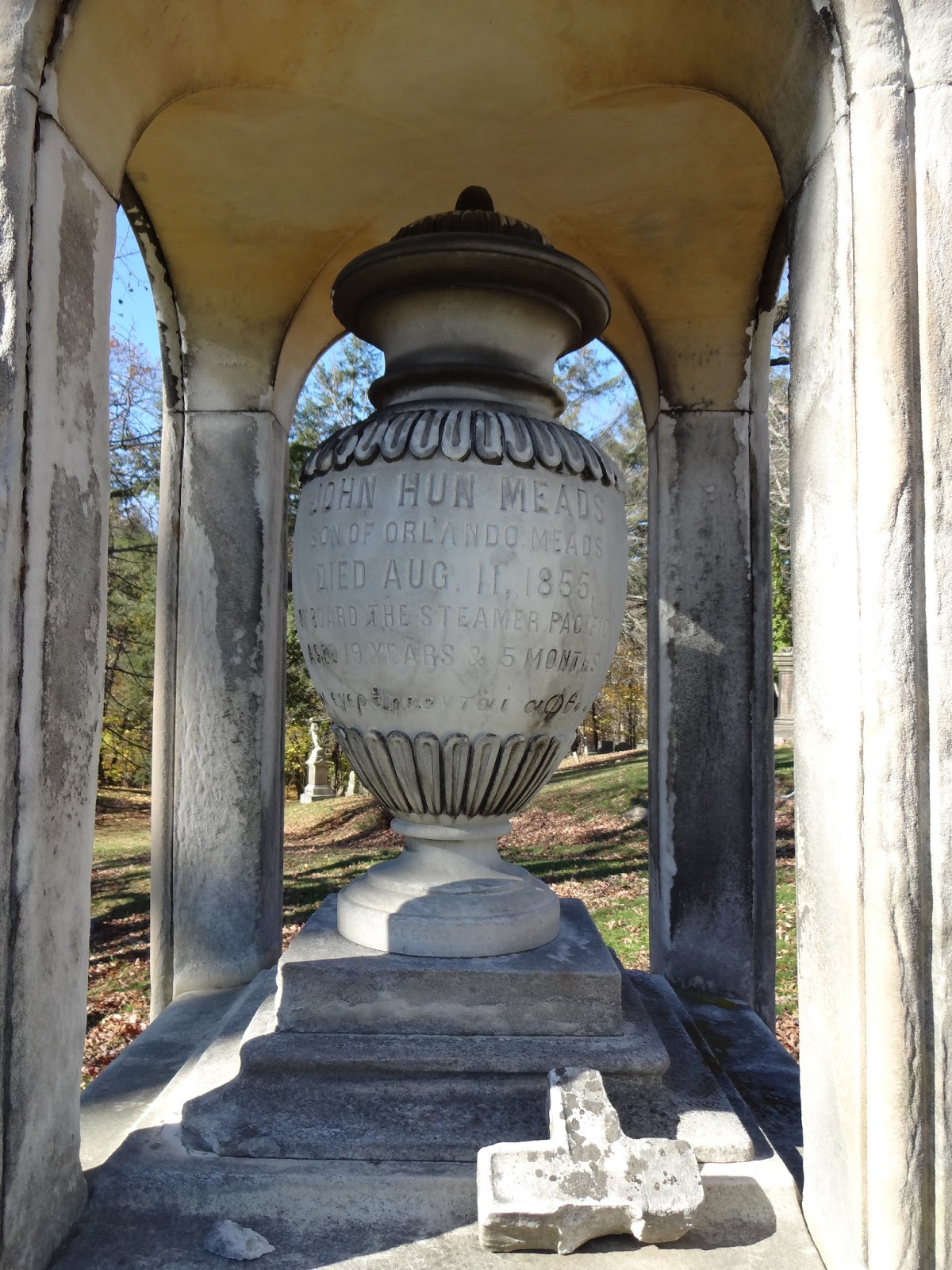
The monument consists of a urn enclosed within a marble canopy. The cross which once topped the monument has fallen off and rests by the urn. It marks the graves of several members of the family of Orlando Meads (a founding member and later president of the Albany Institute), most notably his son.
The inscription on the urn reads:
John Hun Meads Son of Orlando Meads Died Aug. 11, 1855 On Board The Steamer Pacific Aged 19 Years & 5 Months.
There is also a inscription in Greek. Near the base of the urn, is the notation "Buried In Albany" which hints that the urn may have been created first as a memorial to the young man and located elsewhere before being placed in the Cemetery. His father, Orlando, served as president of the Albany Institute of History & Art.
An inscription on the front of the monument bears the name of another John Meads who died in 1870. According to Henry Phelps' history of the Cemetery, John Meads was a great admirer of the Rural Cemetery who visited almost daily. The Fitzgerald guide to the Cemetery describes him as "an old and respected citizen of Albany, who was conspicuous in many noble public charities."

Thursday, February 21, 2013
The G.A.R. Lot

Among the soldiers buried here are several African-American men who served the Union Army, including Private Alfred Dana (Co. I, 31st US Colored Troops, present at Appomattox), James N. Lucas (Co. E, 38th US Colored Troops, a native of Barbados), Corporal Jacob Thompson (Co. K, 26th NYS Colored Infantry), and Sargent William M. Walters (31st US Colored Troops).
Subscribe to:
Posts (Atom)