This photo was taken with a film camera on an overcast day some years ago. At the time, I was looking for a nearby grave and only took a picture of this one because it happened to be there.
The gravestone marks the grave of Smith Weed, a veteran of the Revolutionary War and father-in-law of poet Alfred Billings Street. Weed died on July 11, 1839 at the age of 85. He was originally interred in the State Street Burying Grounds and removed to Alfred B. Street's family lot around 1869.
The sharply-angled tympanum of the marble headstone seems to imitate the outline of an obelisk-style monument and much of the space is filled with a large draped urn with a flame issuing from its opening. A popular image on headstones from the late 18th and early 19th centuries, flaming urns can represent both immortality or eternal friendship. With the veil or shroud draped around it, an urn often represents the death of an older individual. Such urns are also a nod to the funerary urns of Ancient Rome.
Showing posts with label urns. Show all posts
Monday, April 20, 2015
Sunday, February 24, 2013
The Meads Monument
This marble monument stands in the Meads family plot on the Middle Ridge, close to the Young double headstone and Erastus Palmer's monument for Lucia Olcott.
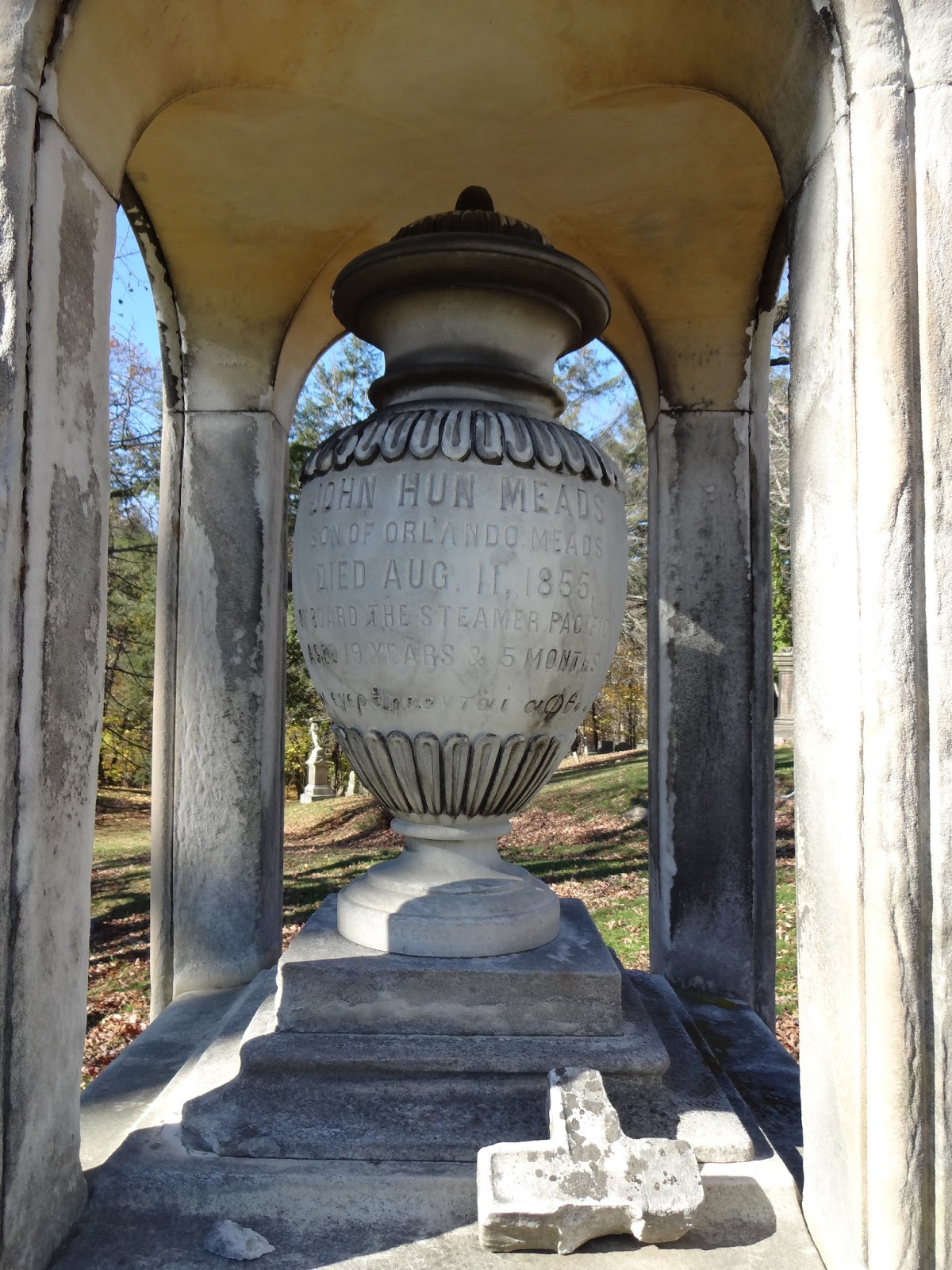
The monument consists of a urn enclosed within a marble canopy. The cross which once topped the monument has fallen off and rests by the urn. It marks the graves of several members of the family of Orlando Meads (a founding member and later president of the Albany Institute), most notably his son.
The inscription on the urn reads:
John Hun Meads Son of Orlando Meads Died Aug. 11, 1855 On Board The Steamer Pacific Aged 19 Years & 5 Months.
There is also a inscription in Greek. Near the base of the urn, is the notation "Buried In Albany" which hints that the urn may have been created first as a memorial to the young man and located elsewhere before being placed in the Cemetery. His father, Orlando, served as president of the Albany Institute of History & Art.
An inscription on the front of the monument bears the name of another John Meads who died in 1870. According to Henry Phelps' history of the Cemetery, John Meads was a great admirer of the Rural Cemetery who visited almost daily. The Fitzgerald guide to the Cemetery describes him as "an old and respected citizen of Albany, who was conspicuous in many noble public charities."
The monument consists of a urn enclosed within a marble canopy. The cross which once topped the monument has fallen off and rests by the urn. It marks the graves of several members of the family of Orlando Meads (a founding member and later president of the Albany Institute), most notably his son.
The inscription on the urn reads:
John Hun Meads Son of Orlando Meads Died Aug. 11, 1855 On Board The Steamer Pacific Aged 19 Years & 5 Months.
There is also a inscription in Greek. Near the base of the urn, is the notation "Buried In Albany" which hints that the urn may have been created first as a memorial to the young man and located elsewhere before being placed in the Cemetery. His father, Orlando, served as president of the Albany Institute of History & Art.
An inscription on the front of the monument bears the name of another John Meads who died in 1870. According to Henry Phelps' history of the Cemetery, John Meads was a great admirer of the Rural Cemetery who visited almost daily. The Fitzgerald guide to the Cemetery describes him as "an old and respected citizen of Albany, who was conspicuous in many noble public charities."
Monday, October 15, 2012
The Old Arsenal Burying Ground
Near the western end of the North Ridge, there is a large corner lot filled with headstones which predate the Rural Cemetery's consecration in 1844. Unlike many of the Cemetery's oldest stones which were transferred here from the State Street Burying Grounds (now Albany's Washington Park), these graves were relocated from the old Arsenal Burying Grounds in nearby Watervliet (formerly known as Gibbonsville and West Troy).
As the name indicates, the Arsenal Burying Grounds stood near the south side of the Watervliet Arsenal. This graveyard originally belonged to the Gibbonsville Reformed Church which was established in 1815. A little less than a century later, this little cemetery (which contained between 275 and 300 graves) was all but abandoned and the Reverend C.P. Evans of Watervliet undertook to copy the inscriptions from the neglected gravestones in 1913. Not long after Reverand Evans' transcription was compiled, the graves and headstones were removed from the Watervliet site and transferred to this lot in the Rural Cemetery.
Among the relocated burials was that of Benjamin Hanks, a veteran of the Revolutionary War and a key figure in the area's bell-making industry.
The stones in the photo above belong to Washington J. Gilbert (died in 1838 at the age of 26), Mary Clinton (the daughter of John and Effy Clinton, died at the age of 11 in 1813), and Almira (wife of Daniel Carthy, died in 1829 at the age of 40). Almira's stone features a very nice willow-and-urn motif.
The simple, pretty stone below, which also features an urn flanked by a pair of graceful willows, is that of Elizabeth Dyer. The wife of William Dyer, she died in 1841 at the age 30.
One interesting occupant of the Arsenal Burying Ground who was not reburied at the Rural Cemetery was Doctor Nelson L. Hungerford. On May 27, 1839, he was killed by a falling rock in the Cave of the Winds at Niagara Falls. Originally buried at the Arsenal, he was later re-interred in Connecticut.
As the name indicates, the Arsenal Burying Grounds stood near the south side of the Watervliet Arsenal. This graveyard originally belonged to the Gibbonsville Reformed Church which was established in 1815. A little less than a century later, this little cemetery (which contained between 275 and 300 graves) was all but abandoned and the Reverend C.P. Evans of Watervliet undertook to copy the inscriptions from the neglected gravestones in 1913. Not long after Reverand Evans' transcription was compiled, the graves and headstones were removed from the Watervliet site and transferred to this lot in the Rural Cemetery.
Among the relocated burials was that of Benjamin Hanks, a veteran of the Revolutionary War and a key figure in the area's bell-making industry.
The stones in the photo above belong to Washington J. Gilbert (died in 1838 at the age of 26), Mary Clinton (the daughter of John and Effy Clinton, died at the age of 11 in 1813), and Almira (wife of Daniel Carthy, died in 1829 at the age of 40). Almira's stone features a very nice willow-and-urn motif.
The simple, pretty stone below, which also features an urn flanked by a pair of graceful willows, is that of Elizabeth Dyer. The wife of William Dyer, she died in 1841 at the age 30.
One interesting occupant of the Arsenal Burying Ground who was not reburied at the Rural Cemetery was Doctor Nelson L. Hungerford. On May 27, 1839, he was killed by a falling rock in the Cave of the Winds at Niagara Falls. Originally buried at the Arsenal, he was later re-interred in Connecticut.
Wednesday, May 2, 2012
Details, Details
I've paused to look at this marble gravestone many times over the past couple of years, but I've never really stopped for a close look. And this richly detailed stone is worth a closer look.
The stone marks the grave of one David Fonda who died in 1805 and was first buried in the Dutch Reformed section of the old State Street Burying Grounds. Since he was buried in a private plot and not the Church Grounds, he may have been privately transferred by family from the Burying Grounds before the City's inventory mass transfer of remains in 1868. A biography of David can be found here.
The stone itself is full of fantastic details. By the early 1800s, the winged skull soul effigies had given way to cherub heads as a popular motif for gravestones and these cherubs were quickly giving way to classical urns and weeping willows. This wonderful stone includes both - a smiling, tilted cherubic face framed by wings above a richly decorated urn. But the busy details don't end there. Two smaller cherubs rest agains the top of the oval tablet, flowers and foliage flank the larger round-cheeked cherub, and swags of carved fabric drape from the urn to the finials of the stone.
The inscription is somewhat worn, but largely still legible:
In Memory of David Fonda
who departed this life
August 3rd A.D. 1805
aged 48 years, 6 months,
and 22 days.
This stone is located on the North Ridge in a section filled with older stones, most of which were brought from other burial grounds after the Rural Cemetery opened in 1844.
Wednesday, December 28, 2011
The Samuel Richards Headstone
Richards was first buried in the Presbyterian section of the municipal burial ground near Eagle Street and State Street (just south of the modern East Capitol Park). It's likely that his grave was moved further uptown to the State Street Burying Ground when that replaced the old downtown graveyards and, finally, his remains and headstone were moved to the Rural Cemetery in 1868.
Richards' white marble stone is beautifully carved with two urns, a symbol of mortality that replaced the winged skulls and cherubic soul effigies popular on headstones in previous generations.
The covered upper urn is framed by an elegant arch. A stylized flower and delicately carved vines which spread out over the monument rise from the lower urn. The surface of the stone is also carved with a cross-hatched pattern giving it an almost woven texture. It's difficult to tell if this stone was signed by its carver as the lower portion is embedded in the earth, but it's one of the finest markers in the Church Grounds and shows a great deal of skill and care.
Subscribe to:
Posts (Atom)