Showing posts with label albany history. Show all posts
Sunday, June 10, 2018
Women' History Tour (And More)
There is still time to register for the June 16 Women's History Tour! This walk along the Cemetery' old Middle Ridge and South Ridge will visit the graves of Revolutionary War poets, Quaker abolitionists, the first woman to be admitted to the New York State Bar, and more. It will start from the Chapel and is this year's NYS Path Through History event.
Registration Information:
Because the walk will include hills and unpaved paths, attendees are asked to wear sensible shoes and bring bug spray. The tour will begin at the Chapel.
The tour is Saturday, June 16 at 10:30 am. Tickets are $15 and space is limited. Email albanyrural1@gmail.com or call the office a 518-463-7017 to register.
There are quite a few tours and events scheduled this year - a full calendar will be posted here soon. Also, restoration work continues at Cypress Pond.
If you are a member of the Friends of Albany Rural Cemetery, you will have noticed that our newsletter is now being published monthly. If you are not a member, please join - we are working very hard to bring you interesting content. A printable copy of the membership form is available here or just stop by our office.
And, because of increased events, we are looking for volunteers. If you are interested, you can pick up a volunteer application form at the office or download one here. Or just email albanyrural1@gmail.com with "Volunteer" in the subject line.
There is much more news, but that's for the next post.
P.S. - I am now a full time member of the office staff at Albany Rural. If you stop by the office Monday through Friday, please say hello! - Paula
Sunday, December 25, 2016
Grief and The Elusive Daniel Campbell.
I first came across this monument - both in person and in Henry P. Phelp's The Albany Rural Cemetery - Its Beauties, Its Memories - while still in high school. Works by Erastus Dow Palmer had already become a favorite "find" at Albany Rural by then. But information on the Daniel Campbell buried here was elusive until recently when I came across a tattered copy of a sermon preached by the Reverend William B. Sprague at an 1851 funeral.
The following is crossposted from my Facebook page, Albany Rural Cemetery - Beyond The Graves. Additional photos are posted there.
---
The following is crossposted from my Facebook page, Albany Rural Cemetery - Beyond The Graves. Additional photos are posted there.
---
Located in Lot 4, Section 18, this monument is quite well documented in early written histories of the Albany Rural Cemetery, but the story behind it is a little more elusive.
In Edward Fitzgerald's 1871 “A Handbook For The Albany Rural Cemetery,” it's described as “a marble obelisk...erected by the young men of Albany” and that its inscription provides “an enduring record of that deed.” In his 1893 “Albany Rural Cemetery – Its Beauties, Its Memories,” Henry P. Phelps goes into a bit more detail and hints at a romance cut short, writing “The monument is of Italian marble and, on the reverse side will be found a bas-relief by Palmer, representing Grief, a bowed female figure, suggestive of the betrothed one whose heart was broken forty years ago.”
The inscription on the south face of the monument reads:
“The young men of the City of Albany, in their grief for his too Early Removal, have erected this Monument to the memory of Daniel Campbell; a man who loved humanity as most love their nearest kindred, and who, as his only riches, the blessings of the needy.”
The north face contains the relief of Grief by Erastus Dow Palmer. It depicts a young woman in a kneeling pose with her head bent and resting on one hand.
The monument, however, gives no further information on the identity of Daniel Campbell. He was obviously much loved, but no date of birth or death is given on the beautiful tombstone.
The lot was deeded to Archibald Campbell, the Scottish immigrant who had served as Acting Secretary of State of New York in the early 1840s and who died in 1856. The Cemetery's burial records list a Daniel D. Campbell in this lot. His index card states that this person died of consumption at the age of 22 on September 3, 1863. This, however, cannot be the same Daniel Campbell honored with the Palmer monument described above.
The Daniel Campbell so beautifully eulogized in marble must have died before 1858 as an engraving of the monument and a copy of the epitaph were included in the second edition Henry W. Churchill's “Guide Through The Albany Rural Cemetery” which was published that year. Erastus Dow Palmer's records indicate that he worked on “Grief” in 1852.
No other Daniel Campbells are recorded in the Cemetery's burial cards so information on his life must be gleaned from other sources. A pamphlet, “Sermon, Address, &c., Occasioned By The Death of Daniel Campbell,” contains both a sermon by the Reverend William Buell Sprague on the Sunday following Daniel Campbell's death. Also printed in the pamphlet is the sermon given by Ray Palmer, Minister of the Congregational Church in Albany.
The funeral's date was October 8, 1851. The newspapers indicate that Campbell died on the morning of October 6 at his father's home. His cause of death was not stated, but an illness is implied.
The fragile booklet also reprints several death notices published in the Albany Argus.
“We discharge a very painful duty in announcing the death of Daniel Campbell, a young gentleman in whose character all the better ingredients of our nature were harmoniously blended, and whose life has been devoted, assiduously, to works of unostentatious goodness and mercy....The deceased was a son of Archibald Campbell. He was born, educated, and has always resided in Albany. His impulses and sympathies, ever warm and generous, were ever prompting him and leading him to do good. He was known in the Schools, at the Asylums, in the Benevolent Societies, at the Young Men's Association and was seen, with his beaming countenance and affectionate manner, wherever aid could be extended to the unfortunate, wherever aid could be extended to the unfortunate or relief administered to the suffering.”
Another notice, from the Albany Express, reported, “On Sunday evening, at the close of a pure and noble life, there passed away from among us one of the choicest spirits of our city – Daniel Campbell. From an easy, natural sleep, he seemed to glide away into the deeper sleep of the good and true who rest from their labors....He was not widely known, but how well and earnestly esteemed, can be learned best among the poor, who he has served for years with a ceaseless and unwearying devotion. Occupying no public office and living so quietly among us that we seemed scarcely so much conscious of his presence as of the works he performed, all unambitious, he was in fact a public benefactor.”
Among the many institutions and charities mentioned in these various printed tributes were the Orphan Asylum, the St. Andrew's Society, the Mission Home, and the Young Men's Association.
Census records and city directories provide a few practical details of his life.
He was the son of Archibald and Mary Campbell. The 1850 census identifies him as a merchant, aged 40, and a member of his father's household (which included three siblings and two servants). The family home was at 60 Chapel Street (near the corner with Pine Street). The 1851 city directory lists him as a coal merchant, a partner in the firm of Belknap, McKercher & Campbell. The business was located at the corner of Broadway and Spencer Street.
There is, however, no hint of just who “the betrothed one” alluded to by Phelps might have been. Her identity remains a mystery.
In Edward Fitzgerald's 1871 “A Handbook For The Albany Rural Cemetery,” it's described as “a marble obelisk...erected by the young men of Albany” and that its inscription provides “an enduring record of that deed.” In his 1893 “Albany Rural Cemetery – Its Beauties, Its Memories,” Henry P. Phelps goes into a bit more detail and hints at a romance cut short, writing “The monument is of Italian marble and, on the reverse side will be found a bas-relief by Palmer, representing Grief, a bowed female figure, suggestive of the betrothed one whose heart was broken forty years ago.”
The inscription on the south face of the monument reads:
“The young men of the City of Albany, in their grief for his too Early Removal, have erected this Monument to the memory of Daniel Campbell; a man who loved humanity as most love their nearest kindred, and who, as his only riches, the blessings of the needy.”
The north face contains the relief of Grief by Erastus Dow Palmer. It depicts a young woman in a kneeling pose with her head bent and resting on one hand.
The monument, however, gives no further information on the identity of Daniel Campbell. He was obviously much loved, but no date of birth or death is given on the beautiful tombstone.
The lot was deeded to Archibald Campbell, the Scottish immigrant who had served as Acting Secretary of State of New York in the early 1840s and who died in 1856. The Cemetery's burial records list a Daniel D. Campbell in this lot. His index card states that this person died of consumption at the age of 22 on September 3, 1863. This, however, cannot be the same Daniel Campbell honored with the Palmer monument described above.
The Daniel Campbell so beautifully eulogized in marble must have died before 1858 as an engraving of the monument and a copy of the epitaph were included in the second edition Henry W. Churchill's “Guide Through The Albany Rural Cemetery” which was published that year. Erastus Dow Palmer's records indicate that he worked on “Grief” in 1852.
No other Daniel Campbells are recorded in the Cemetery's burial cards so information on his life must be gleaned from other sources. A pamphlet, “Sermon, Address, &c., Occasioned By The Death of Daniel Campbell,” contains both a sermon by the Reverend William Buell Sprague on the Sunday following Daniel Campbell's death. Also printed in the pamphlet is the sermon given by Ray Palmer, Minister of the Congregational Church in Albany.
The funeral's date was October 8, 1851. The newspapers indicate that Campbell died on the morning of October 6 at his father's home. His cause of death was not stated, but an illness is implied.
The fragile booklet also reprints several death notices published in the Albany Argus.
“We discharge a very painful duty in announcing the death of Daniel Campbell, a young gentleman in whose character all the better ingredients of our nature were harmoniously blended, and whose life has been devoted, assiduously, to works of unostentatious goodness and mercy....The deceased was a son of Archibald Campbell. He was born, educated, and has always resided in Albany. His impulses and sympathies, ever warm and generous, were ever prompting him and leading him to do good. He was known in the Schools, at the Asylums, in the Benevolent Societies, at the Young Men's Association and was seen, with his beaming countenance and affectionate manner, wherever aid could be extended to the unfortunate, wherever aid could be extended to the unfortunate or relief administered to the suffering.”
Another notice, from the Albany Express, reported, “On Sunday evening, at the close of a pure and noble life, there passed away from among us one of the choicest spirits of our city – Daniel Campbell. From an easy, natural sleep, he seemed to glide away into the deeper sleep of the good and true who rest from their labors....He was not widely known, but how well and earnestly esteemed, can be learned best among the poor, who he has served for years with a ceaseless and unwearying devotion. Occupying no public office and living so quietly among us that we seemed scarcely so much conscious of his presence as of the works he performed, all unambitious, he was in fact a public benefactor.”
Among the many institutions and charities mentioned in these various printed tributes were the Orphan Asylum, the St. Andrew's Society, the Mission Home, and the Young Men's Association.
Census records and city directories provide a few practical details of his life.
He was the son of Archibald and Mary Campbell. The 1850 census identifies him as a merchant, aged 40, and a member of his father's household (which included three siblings and two servants). The family home was at 60 Chapel Street (near the corner with Pine Street). The 1851 city directory lists him as a coal merchant, a partner in the firm of Belknap, McKercher & Campbell. The business was located at the corner of Broadway and Spencer Street.
There is, however, no hint of just who “the betrothed one” alluded to by Phelps might have been. Her identity remains a mystery.
Friday, September 4, 2015
Wednesday, May 13, 2015
The Burial Places of Abraham Ten Broeck
General Abraham Ten Broeck was laid to rest twice before coming to his current and final burial place at the Rural Cemetery.
Born on this date (May 13) in 1734, his name is still a familiar one as a historic home, a street, and a neighborhood all carry it.
The son of Albany merchant Dirck Ten Broeck and Maria Cuyler, Abraham Ten Broeck was educated in business under the supervision of his brother-in-law (and Signer of the Declaration of Independence) Philip Livingston. Abraham Ten Broeck applied his learning to the lumber business; exporting lumber cut from forests north of Albany and importing other goods for sale. Before the Revolution, he owned a dock, lumber yard, and substantial amounts of residential and commercial real estate. In 1763, he married Elizabeth Van Rensselaer, sister of the Patroon, Stephen Van Rensselaer II. When Stephen died at the young age of twenty-seven, Abraham Ten Broeck became an administrator of his estate, the vast Manor of Rensselaerwyck, until Stephen's son and namesake came of age. Ten Broeck's public service included two tenures as Mayor of Albany. During the Revolution, he served with the Albany County Militia and led them at the Battle of Saratoga. He eventually attained the rank of Brigadier General.
In 1798, Abraham Ten Broeck built a handsome brick mansion on a hill just north of Albany. This house, then called Arbor Hill, still stands as a museum and headquarters of the Albany County Historical Association.
When he died on January 19, 1810, the seventy-six year old Abraham Ten Broeck was laid to rest in a private vault on his own estate. The site of the vault (shown in the recent photograph above) was just behind the mansion along what is now Livingston Avenue. The condition of the vault, however, deteriorated, and the remains of General Ten Broeck and his family were removed to the private vault of the Van Rensselaers. This vault was located on the Manor, near the corner of modern day North Pearl and Pleasant Streets This vault was torn down after 1849 and no trace of it survives today. All the remains it had contained were brought to the new Rural Cemetery where they were placed in a large underground vault. Above the vault, a white marble monument forms the centerpiece of the lot. Among the members of the extended Van Rensselaer family laid to rest here was Abraham Ten Broeck.
Ten Broeck's name does not appear on the Van Rensselaer monument, but a small bronze marker and flag-holder at the base honor his memory. It was placed there in 1950 by the Ten Broeck Chapter of the Daughters of the War of 1812.
Tuesday, November 11, 2014
Solomon Van Rensselaer
Solomon Van Rensselaer's tall marble monument is perched on a slope overlooking Ravine Side Way, a path that begins near the remains of Consecration Lake and runs parallel to the Middle Ridge Road at the top of the same slope. Since it overlooks this somewhat secluded walk and faces away from the main road, it's fairly easy to miss. Two of the early histories of the Rural Cemetery - Henry Phelps' The Albany Rural Cemetery - Its Beauties, Its Memories and Edward Fitzgerald's Handbook For The Albany Rural Cemetery - both make substantial mention of this grave site.
Solomon Van Rensselaer was, among other things, a soldier, a U.S. Congressman, postmaster of Albany, and owner of Cherry Hill which had been built by his father-in-law. He is perhaps best known, though, for his service during the War of 1812. Serving under his cousin, General Stephen Van Rensselaer III, he took part in the Battle of Queenstown Heights. During the American defeat there, he was said to have been "riddled" with shots.
He died at the age of seventy-seven on April 23, 1852. His wife, Harriet, had passed twelve years earlier. They were originally buried in the Dutch Reformed Church's cemetery (part of the old municipal burial grounds), but were later moved to this large family plot on the Middle Ridge. However, several newspaper clippings from the 1960s identify his original resting place as Capitol Park where Colonel John Mills was also buried for a time.
More on Solomon Van Rensselaer
Solomon Van Rensselaer was, among other things, a soldier, a U.S. Congressman, postmaster of Albany, and owner of Cherry Hill which had been built by his father-in-law. He is perhaps best known, though, for his service during the War of 1812. Serving under his cousin, General Stephen Van Rensselaer III, he took part in the Battle of Queenstown Heights. During the American defeat there, he was said to have been "riddled" with shots.
He died at the age of seventy-seven on April 23, 1852. His wife, Harriet, had passed twelve years earlier. They were originally buried in the Dutch Reformed Church's cemetery (part of the old municipal burial grounds), but were later moved to this large family plot on the Middle Ridge. However, several newspaper clippings from the 1960s identify his original resting place as Capitol Park where Colonel John Mills was also buried for a time.
More on Solomon Van Rensselaer
Sunday, November 3, 2013
James Eights
James Eights's watercolors are among the few visual records of early 19th-century Albany. Painted in the 1840s, the pictures illustrate the city as it appeared in 1805 (and, in some cases, earlier). Eights worked not only from his own memory, but from maps, documents, and personal recollections of locals.
Eights was born in Albany in 1798 to Dr. Jonathan Eights and his wife, Alidea Wynkoop. His maternal grandfather, Jacobus Wynkoop, was a skipper, boatbuilder, and veteran of the Revolutionary War. Jacobus reportedly built the sloop Experiment which was famous for its 1786 voyage to China.
As a young man, James Eights was appointed as a draftsman working on the geological surveys made for the construction of the Erie Canal. By 1829, he was at sea as a surgeon and naturalist on a voyage to Antarctica. Despite publishing his accounts of the voyage and the later naming of the Eights Coast in his honor, he was not a member of a follow-up expedition to the Southern Hemisphere, apparently as a result of the same alcoholism which would leave him broke later in life.
He returned to Albany in 1830 to live with his parents and, in the 1840s, began work on his series of paintings of his native city. An excellent visual comparison of his historic views with the present can be found here. In addition to painting, he wrote and published a number of reports on geology and history.
Unmarried and destitute, James Eights moved to his sister's home in Ballston Spa where he died of Bright's Disease on June 22 1882. He was eighty-four years old. Two days later, he was buried in his family's plot on the Middle Ridge. The eastern face of the monument bearing his name is rather worn and difficult to read, but his parents' names on the north face of the marble are fairly legible.
Eights was born in Albany in 1798 to Dr. Jonathan Eights and his wife, Alidea Wynkoop. His maternal grandfather, Jacobus Wynkoop, was a skipper, boatbuilder, and veteran of the Revolutionary War. Jacobus reportedly built the sloop Experiment which was famous for its 1786 voyage to China.
As a young man, James Eights was appointed as a draftsman working on the geological surveys made for the construction of the Erie Canal. By 1829, he was at sea as a surgeon and naturalist on a voyage to Antarctica. Despite publishing his accounts of the voyage and the later naming of the Eights Coast in his honor, he was not a member of a follow-up expedition to the Southern Hemisphere, apparently as a result of the same alcoholism which would leave him broke later in life.
He returned to Albany in 1830 to live with his parents and, in the 1840s, began work on his series of paintings of his native city. An excellent visual comparison of his historic views with the present can be found here. In addition to painting, he wrote and published a number of reports on geology and history.
Unmarried and destitute, James Eights moved to his sister's home in Ballston Spa where he died of Bright's Disease on June 22 1882. He was eighty-four years old. Two days later, he was buried in his family's plot on the Middle Ridge. The eastern face of the monument bearing his name is rather worn and difficult to read, but his parents' names on the north face of the marble are fairly legible.
Sunday, July 28, 2013
Murdered At Cherry Hill
The weathered marble monument isn't particularly distinctive from a distance. It's darkened to deep gray by the elements and the style - loosely patterned on ancient Hebrew altars - can be found repeated several times throughout the Cemetery. Take a closer look, though, and the inscription reveals a name connected to one of Albany's most famous crimes.
John Whipple Born at Sunderland, Vermont August 11, 1793. Father Was An Officer In The Revolutionary War.
The date of his death is not given with the longer description on the back, but his name is repeated on the front with the following dates: 1793-1827.
The newspapers - both local and beyond - carried the following description of his death.
One of the most horrible instances of deliberate assassination that we have ever been called upon to record, was committed in the vicinity of Albany...the victim, John Whipple, who whilst writing in a back room in the second-story of his dwelling-house on Cherry Hill, a mile below the city, between 9 and 10 o'clock last night, was fired at through the sash, with a pistol. The ball passed through and shattered a pane of glass, entered the body of Mr. Whipple through the blade bone of his left shoulder, cut one of the principal arteries of the heart, and lodged in the right lobe of the lungs....When he was shot, he rose from his seat, exclaimed, 'My God! what was that!" and made for the door at the head of the stairs, descended a step or two, fell, and instantly expired. The wife of Mr. W. had been in the room but a moment before, and the next time she saw her husband he was a lifeless corpse! Her feelings may easier by imagined than described.
His wife, of course, was Elsie Lansing Whipple, and before long, she and her lover, a handyman named Jesse Strang, were implicated in the murder of John Whipple and the subsequent trial became front page news across the country.
Elsie was a Van Rensselaer on her mother's side. Her father, Abraham A. Lansing, was successful businessman who could afford to own eleven slaves. Her father died while Elsie was quite young and, at the age of fourteen, Elsie (who was described as a pampered and difficult girl) eloped with John Whipple. He was a neighbor and nine years her senior. Her family initially disapproved of the match, believing Whipple was only after Elsie's money. However, Whipple proved to be a sensible guardian of her inheritance and greatly increased it through a good combination of business skill and wise investment. After his death, the newspapers described John Whipple as "in the prime of life, industrious, enterprising, and fair in all his transactions...a valuable and intelligent citizen."
John and Elsie Whipple had one son, Abraham, born in 1821.
Elsie, however, caught the eye of a man named Joe Orton. Elsie met him at a nearby tavern where he worked. Not long after, he moved to the Cherry Hill estate as a handyman and the pair eventually became lovers. First came the daily exchange of passionate letters, followed by trysts. They wanted to run away together, but lacked the funds to do so. Elsie's money belonged, under the law, to her husband. As for her lover, his name wasn't really Joe Orton. He was Jesse Strang, a man who'd abandoned his wife and children in Fishkill, moved first to Ohio and then back to western New York where he faked his death before coming to Albany.
Divorce was unthinkable. Aside from the social scandal it would cause, it would leave Elsie penniless. The lovers decided murder was their best option. John Whipple's death would leave Elsie single and rich. Elsie first tried to poison him with arsenic, but the dose was too low. John was sickened, but survived.
Elsie offered to give Jesse one of her husband's own pistols to commit the deed, but Jesse declined and bought a flintlock. The pair then spread rumors than unknown enemies were out to kill John over a business matter and claimed to see prowlers around the estate. Then, on the night of May 7, 1827, Jessie climbed onto a shed at the rear of the Cherry Hill mansion and fired the fatal shot through the closed window.
Elsie and Jesse planned to elope to Montreal, but at the coroner's hearing, Jesse's over-enthusiastic testimony about prowlers raised suspicions. Just two days after the murder, he was arrested. Two weeks later, Elsie was also arrested.
The trial shocked the city. It attracted such great crowds that it had to be moved from the courthouse to the Assembly Chamber at the State Capitol. The sordid mix of sex, money, respected family names, and murder was a great draw and, when Jesse was convicted and executed for the murder of John Whipple, his hanging attracted nearly a crowd of nearly forty thousand (a spectacle that lead city officials to end the practice of public hangings in Albany). Elsie stood trial separately. The judge refused to let Jess testify and the jury acquitted her without even rising from their seats. Albany was not prepared to condemn a woman with ties to some of its most prominent families, regardless of the evidence. Little is known about Elsie's later life. After the murder of her husband and the hanging of her lover, Elsie married Nathaniel Freeman in Brunswick, New Jersey. She died in 1832.
John Whipple, murdered at Cherry Hill, was buried in the Episcopal lot at the State Street Burying Grounds. His entry in the Common Council's inventory of burials makes note that he was "murdered at Cherry Hill." When the graves were removed forty years later, John was not transferred to the Church Grounds, but privately reburied in this North Ridge lot purchased by his son, Abraham Lansing Whipple. Abraham and his wife, Hannah, are also buried here.
Cherry Hill, the mansion at Albany's southern edge, made news again in the past week. The site was faced with the possibility of closure, but generous donations prevented the loss of one of Albany's finest historic treasures. In a city that has lost much of its early history, the Cherry Hill mansion is marvelously intact and contains generations of family possessions. See the Times Union stories for more details:
Albany Mansion May Be History
Donors Keep Cherry Hill From Closing
Support is still needed and donations can be made at Cherry Hill's site:
Historic Cherry Hill
Wednesday, July 3, 2013
At Gettysburg
Easily visible along the stretch of South Ridge Road that curves up hill from the main office, this marble tree stump is one of the many graves of fallen Civil War soldiers at the Albany Rural Cemetery.
The tree, truncated and without branches, indicates a life ended in its prime. A soldiers' cap lies on the roots, a flag wraps around the trunk, the stone bases is carved with the names of the fourteen battles in which this young man fought (including Antietam, Fredericksburg, Chancellorsville, and Fairfax Courthouse).
This beautiful monument marks the grave of Lieutenant William Pohlman. He was born in 1842 Borneo to missionary parents, but raised in Albany by an aunt following the death of his mother. He was a student at Rutgers University when the war began and soon enlisted in the 1st New Jersey Infantry Regiment. By the following year, Pohlman was a Lieutenant and Adjutant in the 59th New York Infantry.
On July 3, Lt. Pohlman was struck in the arm by shrapnel from a cannon at Gettysburg. Wounded, he continued to fight until shot in the arm during Pickett's Charge. He was first brought to a field hospital, about a week later transferred to the hospital set up in the nearby Swopes Mansion. A surgeon was brought from Baltimore to examine him and, at first, it seems the young man would recover. He was able to receive visitors and wrote to his sister to ask her to come see him. He would ask every day if she had arrived. But on July 20, his condition worsened. Following a hemorrhage, he entered into a brief coma. He regained consciousness on the 21st, but was confused and called out, "Cease firing!" They were his final words, now carved on his monument's canon. His body was embalmed and returned to Albany for burial.
He was buried in the plot belonging to his uncle, the Reverend Henry Newman Pohlman, the former pastor of Albany's 1st Lutheran Church. It was Rev. Pohlman who oversaw the Cemetery's consecration ceremonies in 1844.
The shield on the front of the younger Pohlman's headstone reads:
Died July 21, 1863 At Gettysburg From Wounds Received In Battle In The 22nd Year of His Age
Click here for a more extensive bio of Lt. William Pohlman, including photos
The tree, truncated and without branches, indicates a life ended in its prime. A soldiers' cap lies on the roots, a flag wraps around the trunk, the stone bases is carved with the names of the fourteen battles in which this young man fought (including Antietam, Fredericksburg, Chancellorsville, and Fairfax Courthouse).
This beautiful monument marks the grave of Lieutenant William Pohlman. He was born in 1842 Borneo to missionary parents, but raised in Albany by an aunt following the death of his mother. He was a student at Rutgers University when the war began and soon enlisted in the 1st New Jersey Infantry Regiment. By the following year, Pohlman was a Lieutenant and Adjutant in the 59th New York Infantry.
On July 3, Lt. Pohlman was struck in the arm by shrapnel from a cannon at Gettysburg. Wounded, he continued to fight until shot in the arm during Pickett's Charge. He was first brought to a field hospital, about a week later transferred to the hospital set up in the nearby Swopes Mansion. A surgeon was brought from Baltimore to examine him and, at first, it seems the young man would recover. He was able to receive visitors and wrote to his sister to ask her to come see him. He would ask every day if she had arrived. But on July 20, his condition worsened. Following a hemorrhage, he entered into a brief coma. He regained consciousness on the 21st, but was confused and called out, "Cease firing!" They were his final words, now carved on his monument's canon. His body was embalmed and returned to Albany for burial.
Grave of Rev. Henry Newman Pohlman
The shield on the front of the younger Pohlman's headstone reads:
Died July 21, 1863 At Gettysburg From Wounds Received In Battle In The 22nd Year of His Age
Click here for a more extensive bio of Lt. William Pohlman, including photos
Tuesday, February 26, 2013
Captain Samuel Schuyler
This towering marble monument with anchors carved on both its east and west faces stands on the brow of the Middle Ridge with a commanding view of the Hudson River and valley below.
Anchors on headstones often represent steadfast faith and are found on a number of graves in Albany Rural Cemetery. In this case, they also symbolize the occupation of the deceased (such as the Bogart and Townsend monuments)
He was born in 1781, but very little is known of Samuel Schuyler's origins, though it has been speculated that he was a descendent of the prominent Albany family of the same name. Sometime prior to 1805, he married Mary Martin-Morin; the couple would have eleven children.
Like many other African-Americans of his era, Samuel began his working life as a laborer on Quay Street, along Albany's thriving waterfront. Within five years of his marriage, though, he had his own boat to haul lumber, produce, and other goods. He would expand his business interest to real estate, owning a substantial number of lots along South Pearl Street. His sons would join him in business, as partners in a flour and feed store and, later, they would establish the Schuyler Towboat Company.
Captain Schuyler died in 1842 and was buried in this lot which also holds the graves of three generations of his family. It's interesting to note that, when his son and namesake died in 1894, the New York Times obituary made no mention of the family's African-American heritage and referred to his ancestors as "the early Dutch settlers of Albany."
Anchors on headstones often represent steadfast faith and are found on a number of graves in Albany Rural Cemetery. In this case, they also symbolize the occupation of the deceased (such as the Bogart and Townsend monuments)
He was born in 1781, but very little is known of Samuel Schuyler's origins, though it has been speculated that he was a descendent of the prominent Albany family of the same name. Sometime prior to 1805, he married Mary Martin-Morin; the couple would have eleven children.
Like many other African-Americans of his era, Samuel began his working life as a laborer on Quay Street, along Albany's thriving waterfront. Within five years of his marriage, though, he had his own boat to haul lumber, produce, and other goods. He would expand his business interest to real estate, owning a substantial number of lots along South Pearl Street. His sons would join him in business, as partners in a flour and feed store and, later, they would establish the Schuyler Towboat Company.
Captain Schuyler died in 1842 and was buried in this lot which also holds the graves of three generations of his family. It's interesting to note that, when his son and namesake died in 1894, the New York Times obituary made no mention of the family's African-American heritage and referred to his ancestors as "the early Dutch settlers of Albany."
Friday, February 1, 2013
Simeon DeWitt
This small marble headstone marking the grave of Simeon DeWitt, who served as both Surveyor General of New York State and of the United States, sits in a little hollow just above the low path which runs along the south shoulder of the Middle Ridge.
A native of Warswarsing, New York, Simeon DeWitt was educated at Queens College and served in the Revolutionary War, including at the Battle of Saratoga. He would later describe the surrender of the British troops under General John Burgoyne as "the most glorious, grandest sight America ever held." During the War, DeWitt also served as an assistant geographer to Robert Erkine, the U.S. Army's first surveyor. When Erkine died in 1780, DeWitt was chosen by General Washington as his replacement.
In 1784, DeWitt was appointed Surveyor General of New York State, a post he would hold for over fifty years. He would map almost the entire state, giving names to counties and towns established after the war. At the same time, he settled in Albany and his 1790 map of the city is a valuable record of the city's early development and geological features long since lost to progress. Many streets in Albany were given names by DeWitt which are still in use today; among them are Elk, Beaver, Eagle, Hawk, Swan, Dove, Lark, Robin, Quail.
In 1794, DeWitt acquired land along Market Street (Broadway); the property included the ruins of Albany's first permanent European settlement, Fort Orange. He built a brick home on the land and resided there until around 1810 when he relocated to Ithaca, one of the towns he'd named in Central New York.
He died in 1834 and was originally buried in Ithaca. A decade later, his body was returned to Albany and reburied, first in the vault of the Middle Dutch Church and then, in 1854, to this quiet spot in the Rural Cemetery. A metal marker from the Daughters of the American Revolution was added to the gravesite to recall his service.
A native of Warswarsing, New York, Simeon DeWitt was educated at Queens College and served in the Revolutionary War, including at the Battle of Saratoga. He would later describe the surrender of the British troops under General John Burgoyne as "the most glorious, grandest sight America ever held." During the War, DeWitt also served as an assistant geographer to Robert Erkine, the U.S. Army's first surveyor. When Erkine died in 1780, DeWitt was chosen by General Washington as his replacement.
In 1784, DeWitt was appointed Surveyor General of New York State, a post he would hold for over fifty years. He would map almost the entire state, giving names to counties and towns established after the war. At the same time, he settled in Albany and his 1790 map of the city is a valuable record of the city's early development and geological features long since lost to progress. Many streets in Albany were given names by DeWitt which are still in use today; among them are Elk, Beaver, Eagle, Hawk, Swan, Dove, Lark, Robin, Quail.
In 1794, DeWitt acquired land along Market Street (Broadway); the property included the ruins of Albany's first permanent European settlement, Fort Orange. He built a brick home on the land and resided there until around 1810 when he relocated to Ithaca, one of the towns he'd named in Central New York.
He died in 1834 and was originally buried in Ithaca. A decade later, his body was returned to Albany and reburied, first in the vault of the Middle Dutch Church and then, in 1854, to this quiet spot in the Rural Cemetery. A metal marker from the Daughters of the American Revolution was added to the gravesite to recall his service.
Friday, December 21, 2012
Church Grounds Pieces
Fragments of broken stones in the Church Grounds section. If you aren't following it already, please see my companion blog focusing on this historic area of the Rural Cemetery and the people buried there.
The Albany Church Grounds
Saturday, November 24, 2012
Frederick Hinckel
This stately figure of Hope stands facing Cypress Water on the South Ridge. It marks the grave of Frederick Hinckel and his family.
Hinckel's name is familiar to anyone with an interest in the history of Albany's many breweries. With a partner, he founded the Cataract Brewery in 1857. It was originally named for its location overlooking Buttermilks Falls (now a part of the sewer running through Lincoln Park's ravine). Hinckel bought out his partner and changed the brewery's name. In 1880, he built a complex of handsome brick buildings to house the business which was said to be one of the best equipped breweries in the United States. The old brewery still stands across from Lincoln Park and has been converted into an apartment building.
Albany was once famous for its numerous breweries and there was obviously good money in the business as their owners were buried beneath some of the finest monuments in the Rural Cemetery, including this one in one of the most expensive sections and the elaborate Boyd marble on the Middle Ridge.
Hinckel's name is familiar to anyone with an interest in the history of Albany's many breweries. With a partner, he founded the Cataract Brewery in 1857. It was originally named for its location overlooking Buttermilks Falls (now a part of the sewer running through Lincoln Park's ravine). Hinckel bought out his partner and changed the brewery's name. In 1880, he built a complex of handsome brick buildings to house the business which was said to be one of the best equipped breweries in the United States. The old brewery still stands across from Lincoln Park and has been converted into an apartment building.
Albany was once famous for its numerous breweries and there was obviously good money in the business as their owners were buried beneath some of the finest monuments in the Rural Cemetery, including this one in one of the most expensive sections and the elaborate Boyd marble on the Middle Ridge.
Thursday, September 27, 2012
Senator Ira Harris
This massive square granite headstone in an old section of the South Ridge (not too far from the lovely grave of Daniel Campbell) marks the grave of Senator Ira Harris, a man whose family history is closely linked to the Lincoln assassination.
Harris was born in 1802 on a farm near Charleston, Montgomery County. Educated at Union College, he was admitted to the bar in 1828 and practiced law in Albany. His active political and civic career included tenures the New York State Assembly, the New York State Constitutional Convention (1846), New York State Senate, and New York State Supreme Court. He also served as president of Union College and was a founder of Albany Law School.
In 1861, he was elected to the United States Senate to replace William H. Seward after the latter was appointed Secretary of State by President Abraham Lincoln. Senator Harris would become a friend of the President and a regular visitor to the Lincoln White House (which led to a joke that Lincoln would check under his bed each night to make sure Senator Harris was not there with yet another patronage request).
On the night that Lincoln was assassinated at Ford's Theatre, his guests for the evening were Senator Harris' daughter, Clara, and her fiance, Colonel Henry Rathbone (who was also Senator Harris' stepson). Rathbone was wounded by Booth's knife during the assassination and his failure to prevent the President's death would haunt Henry for the rest of his life. In 1883, suffering from declining mental health, Henry stabbed Clara to death and attempted to take his own life (he survived, was declared insane, and died in an asylum in 1911).
Senator Ira Harris' summer home just off modern-day Route 9 in Loudonville still stands. Located just minutes from the South Gate of the Albany Rural Cemetery, the old Loudon Cottage (which is privately owned) is said to be haunted by Lincoln. Clara's evening gown, stained with Lincoln's blood, was reportedly sealed in a closet there and the slain President's ghost has been seen there by a number of people, beginning with Clara who is said to have seen the apparition on the first anniversary of the assassination.
Senator Ira Harris died on December 2, 1873 after an illness described in contemporary accounts as "paralysis." He was buried in his family's lot at the Rural Cemetery. The back of the monument lists other member of the Harris family interred there.
Ira Harris was also a part of the Rural Cemetery's history; he was a founding member of the Albany Cemetery Association and served as a Trustee of the Cemetery from its incorporation until his death. It was Harris who, after receiving a letter from the General's granddaughter, presented the resolution to have Phillip Schuyler's remains transferred from an obscure grave in the Van Rensselaer family lot to a new lot marked with a fine column more in keeping with Schuyler's legacy as a key figure in the region's Revolutionary-era history.
Harris was born in 1802 on a farm near Charleston, Montgomery County. Educated at Union College, he was admitted to the bar in 1828 and practiced law in Albany. His active political and civic career included tenures the New York State Assembly, the New York State Constitutional Convention (1846), New York State Senate, and New York State Supreme Court. He also served as president of Union College and was a founder of Albany Law School.
In 1861, he was elected to the United States Senate to replace William H. Seward after the latter was appointed Secretary of State by President Abraham Lincoln. Senator Harris would become a friend of the President and a regular visitor to the Lincoln White House (which led to a joke that Lincoln would check under his bed each night to make sure Senator Harris was not there with yet another patronage request).
On the night that Lincoln was assassinated at Ford's Theatre, his guests for the evening were Senator Harris' daughter, Clara, and her fiance, Colonel Henry Rathbone (who was also Senator Harris' stepson). Rathbone was wounded by Booth's knife during the assassination and his failure to prevent the President's death would haunt Henry for the rest of his life. In 1883, suffering from declining mental health, Henry stabbed Clara to death and attempted to take his own life (he survived, was declared insane, and died in an asylum in 1911).
Senator Ira Harris' summer home just off modern-day Route 9 in Loudonville still stands. Located just minutes from the South Gate of the Albany Rural Cemetery, the old Loudon Cottage (which is privately owned) is said to be haunted by Lincoln. Clara's evening gown, stained with Lincoln's blood, was reportedly sealed in a closet there and the slain President's ghost has been seen there by a number of people, beginning with Clara who is said to have seen the apparition on the first anniversary of the assassination.
Senator Ira Harris died on December 2, 1873 after an illness described in contemporary accounts as "paralysis." He was buried in his family's lot at the Rural Cemetery. The back of the monument lists other member of the Harris family interred there.
Ira Harris was also a part of the Rural Cemetery's history; he was a founding member of the Albany Cemetery Association and served as a Trustee of the Cemetery from its incorporation until his death. It was Harris who, after receiving a letter from the General's granddaughter, presented the resolution to have Phillip Schuyler's remains transferred from an obscure grave in the Van Rensselaer family lot to a new lot marked with a fine column more in keeping with Schuyler's legacy as a key figure in the region's Revolutionary-era history.
Monday, September 10, 2012
Captain Townsend's Anchor
The Townsend family plot is a large fenced lot alongside the Moordanaers Kill on a low path between the Cemetery's Middle and South Ridges. Located just across from the De Peyster Douw hillside crypt, it contains a number of noteworthy graves, but the most distinctive monument here is undoubtedly the massive granite anchor marking the resting place of Captain Robert Townsend.
A member of a prominent Albany family which included mayors, generals, and businessmen, Captain Townsend served in the U.S. Navy during the Mexican War (commanding the Porpoise) and the Civil War (commanding the Miami and Essex). At the age of forty-six, he died of heatstroke in China while in command of the Wachusett
A set of historic artifacts which once belonged to Captain Robert Townsend was recently the subject of a Times Union article.
The photo below shows Townsend lot as it appeared in the late 1800s. An early history of the Cemetery describes the anchor tomb as "at once elegant, modest, and substantial."
Anchors appears on a number of other monuments in the Cemetery (such as the John Bogart marble), either as a symbol of steadfast faith or an emblem of a maritime career.
(An iron cover made by the Townsend Furnace can still be seen near the Capitol. Click here for a photo.)
Thursday, August 9, 2012
Edward Delavan
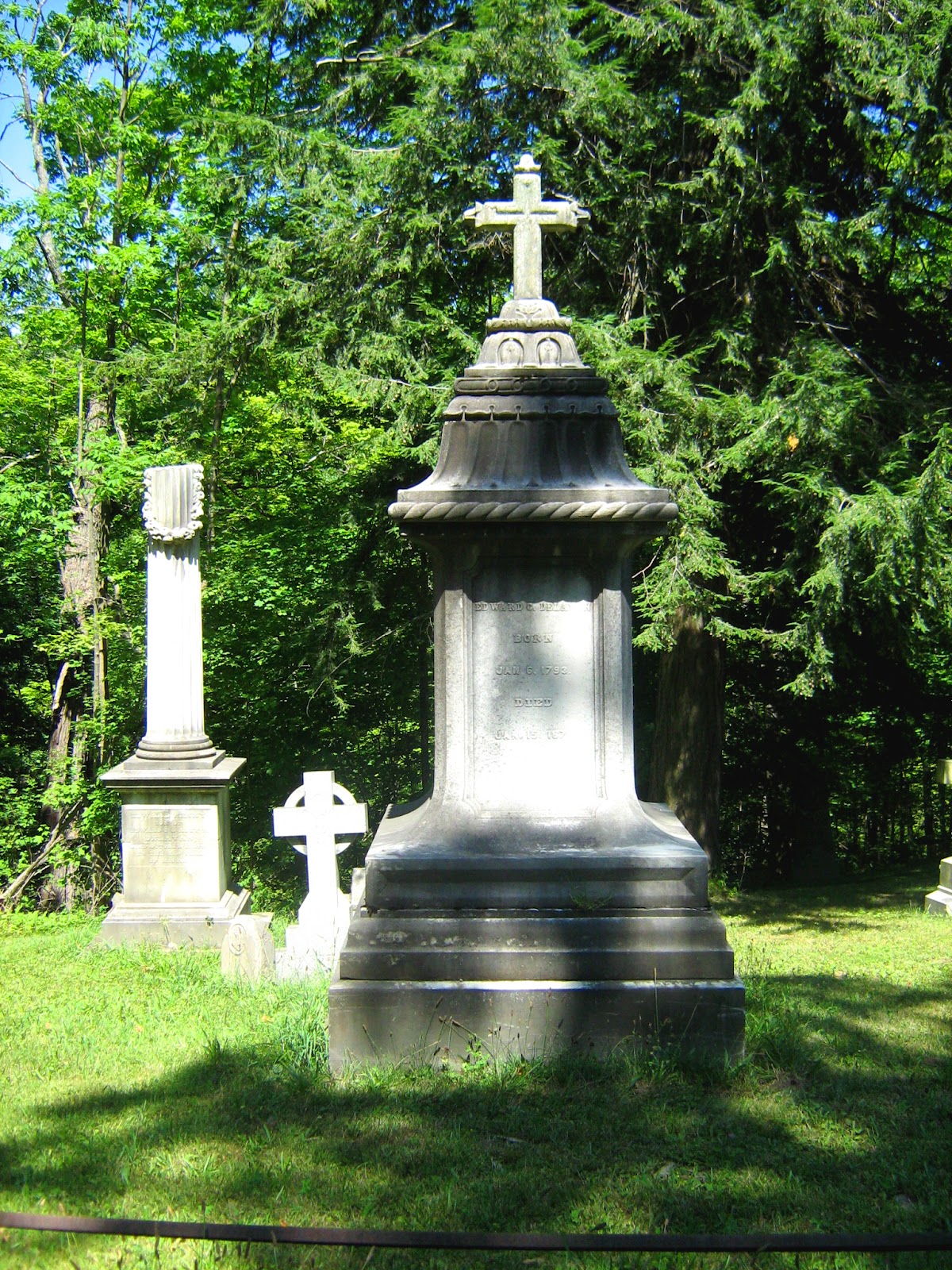
This cross-topped marble monument on the Cemetery's high Middle Ridge marks the grave of Edward C. Delavan, a prominent Albany hotel owner and temperance advocate.
Mr. Delavan owned the eponymous Delavan House, one of old Albany's most famous hotels. Located on Broadway on the site of Union Station, the hotel hosted Charles Dickens, the Lincoln family, Boss Tweed (he used a luxury suite there as his local headquarters, complete with a private entrance), Theodore Roosevelt, and many other famous figures before it was destroyed in one of the city's worst fires. Nineteen people were killed in the inferno on December 30, 1894.
Born in Westchester County in 1793, Delavan was one of the wealthiest New Yorkers by 1860. Much of his fortune had been made in real estate investments after the opening of the Erie Canal.
Despite an early career as a wine merchant, Edward Delavan was, by the late 1820s, a fanatic participant in the temperance movement and founding member of the American Temperance Union. He is said to have emptied the entire contents of his own expensive wine cellar into the gutters. He also traveled to Europe to promote temperance in Italy and France, both countries famed for their wine production and consumption. An enthusiastic propagandist, he used his personal wealth to distribute a million temperance tracts to Union soldiers during the Civil War.
Of course, a "dry" hotel was not profitable and the managers of his Delavan House reportedly found loopholes in the establishment's lease which allowed wine and liquour to be served there despite its owner's zealous objections to all alcohol.
It was Edward Delavan who bought the first deed to a lot at the new Albany Rural Cemetery in 1845. He was buried there after his death in 1871.
Sunday, July 29, 2012
Captain William T. Wooley
This marble stone with a cap and sword marks the grave of Captain William T. Wooley of the Albany Republican Artillery. During the Civil War, he served with Company A of the 25th New York State Militia.
According to Rufus Wheelwright Clark's 1867 Heroes of Albany: A Memorial To The Patriot-Martyrs of The City and County of Albany, Wooley's patriotism was "strikingly conspicuous."
He was one of the first to respond to the call of his country, and in spite of ill health, and the remonstrances of friends who felt that his impaired strength rendered him unfit for service, he persevered in his efforts for the defense of the nation until his death which occurred in the Georgetown hospital, July 13, 1861.
Wooley was thirty-four at the time of his death. His wife, Susan, is also buried here. She survived him by thirteen years.
The Wooley monument stands in a rather secluded section of the North Ridge. Half-lost in a waist-high mix of grass, clover, and Queen Anne's Lace, it was apparently overlooked when new flags were placed on the graves of soldiers this past Memorial Day.
According to Rufus Wheelwright Clark's 1867 Heroes of Albany: A Memorial To The Patriot-Martyrs of The City and County of Albany, Wooley's patriotism was "strikingly conspicuous."
He was one of the first to respond to the call of his country, and in spite of ill health, and the remonstrances of friends who felt that his impaired strength rendered him unfit for service, he persevered in his efforts for the defense of the nation until his death which occurred in the Georgetown hospital, July 13, 1861.
Wooley was thirty-four at the time of his death. His wife, Susan, is also buried here. She survived him by thirteen years.
The Wooley monument stands in a rather secluded section of the North Ridge. Half-lost in a waist-high mix of grass, clover, and Queen Anne's Lace, it was apparently overlooked when new flags were placed on the graves of soldiers this past Memorial Day.
Thursday, July 26, 2012
Rensselaer Westerlo
This large, simple sandstone cross is located in the oldest section of the Cemetery's North Ridge, an area called Beaulieu Hill and Kennesau Hill on the oldest maps of the grounds and Landscape Hill on later maps.
The cross marks the grave of Rensselaer Westerlo who represented New York's 9th District in the U.S. House of Representatives from 1817 to 1819.
Rensselaer Westerlo was connected to several of the area's most prominent families. His father was the Reverand Eilardus Westerlo, a native of Holland who served as the greatly influential pastor of Albany's First Dutch Reformed Church during the Revolutionary War. His mother, Catharina, was the daughter of Philip Livingston, a Signer of the Declaration of Independence. By her first husband, Catharina was the mother of Albany's "Last Patroon," Stephen Van Rensselaer II. Rensselar Westerlo's wife, Jane, was the daughter of the State Chancellor, John J. Lansing.
This handsome stone was erected by Rensselaer Westerlo's children following his death on April 18, 1851. He was less than a month away from his 75th birthday. The base of the monument is carved with words from The Book of Genesis: He was not, for God took him.
Several other members of Westerlo's family are buried in this lot; an inscription on the east side notes that a son named Eilardus died in California in 1859.
The Westerlo lot is quite close to the Lochner, Gould, and Disney plots.
The cross marks the grave of Rensselaer Westerlo who represented New York's 9th District in the U.S. House of Representatives from 1817 to 1819.
Rensselaer Westerlo was connected to several of the area's most prominent families. His father was the Reverand Eilardus Westerlo, a native of Holland who served as the greatly influential pastor of Albany's First Dutch Reformed Church during the Revolutionary War. His mother, Catharina, was the daughter of Philip Livingston, a Signer of the Declaration of Independence. By her first husband, Catharina was the mother of Albany's "Last Patroon," Stephen Van Rensselaer II. Rensselar Westerlo's wife, Jane, was the daughter of the State Chancellor, John J. Lansing.
This handsome stone was erected by Rensselaer Westerlo's children following his death on April 18, 1851. He was less than a month away from his 75th birthday. The base of the monument is carved with words from The Book of Genesis: He was not, for God took him.
Several other members of Westerlo's family are buried in this lot; an inscription on the east side notes that a son named Eilardus died in California in 1859.
The Westerlo lot is quite close to the Lochner, Gould, and Disney plots.
Sunday, July 1, 2012
Tumbled
The steep hillside and shifting earth have caused this old marble monument to fall down onto Ravine Side Way, a low grassy path running along the south shoulder of the Middle Ridge.
Saturday, June 30, 2012
Amavimus
This low sarcophagus-style monument of rough-cut granite blocks is topped by two
delicate, but rusty urns of painted cast iron. The monument was
erected for Kittie Hall, wife of prominent surgeon John Lochner.
Beneath her name and the dates of her birth and death is the single
word amavimus, Latin for “we have loved.” It's located on the North Ridge near the Soldiers Lot and Gould monument.
Friday, June 29, 2012
The Witt Crypt
This old vault is obscured by its location on a low path which runs parallel to the Cemetery's South Ridge Road. Built into the hillside, its roof vents can be seen from the plot of Little Georgie. With its entrance now sealed with stone blocks and its approach ankle-deep in leaves or grass (depending on the season), it looks rather forlorn now, but still retains some elegance with its wonderful rose-colored granite pillars (one of which is sadly missing) and arched doorway.
The crypt was built for Stillman Witt, a millionaire industrialist and philanthropist from Cleveland. Witt died at sea while on a trip for his health. His 1875 obituary from the New York Times can be read here.
When it was first built, this would've been considered a very fine location. There are a number of notable plots along this path - including the Strong family and Mayor Eli Perry. The crypt would have also overlooked Consecration Lake with its scenic ravine paths.
The crypt was built for Stillman Witt, a millionaire industrialist and philanthropist from Cleveland. Witt died at sea while on a trip for his health. His 1875 obituary from the New York Times can be read here.
When it was first built, this would've been considered a very fine location. There are a number of notable plots along this path - including the Strong family and Mayor Eli Perry. The crypt would have also overlooked Consecration Lake with its scenic ravine paths.
Subscribe to:
Posts (Atom)